



Washtenaw County had been continuously inhabited for a few thousand years before Europeans arrived, and there was a mix of Native American, European and African American people here for about two hundred years by the time Washtenaw County officially split off from Wayne County to become its own entity two centuries ago.
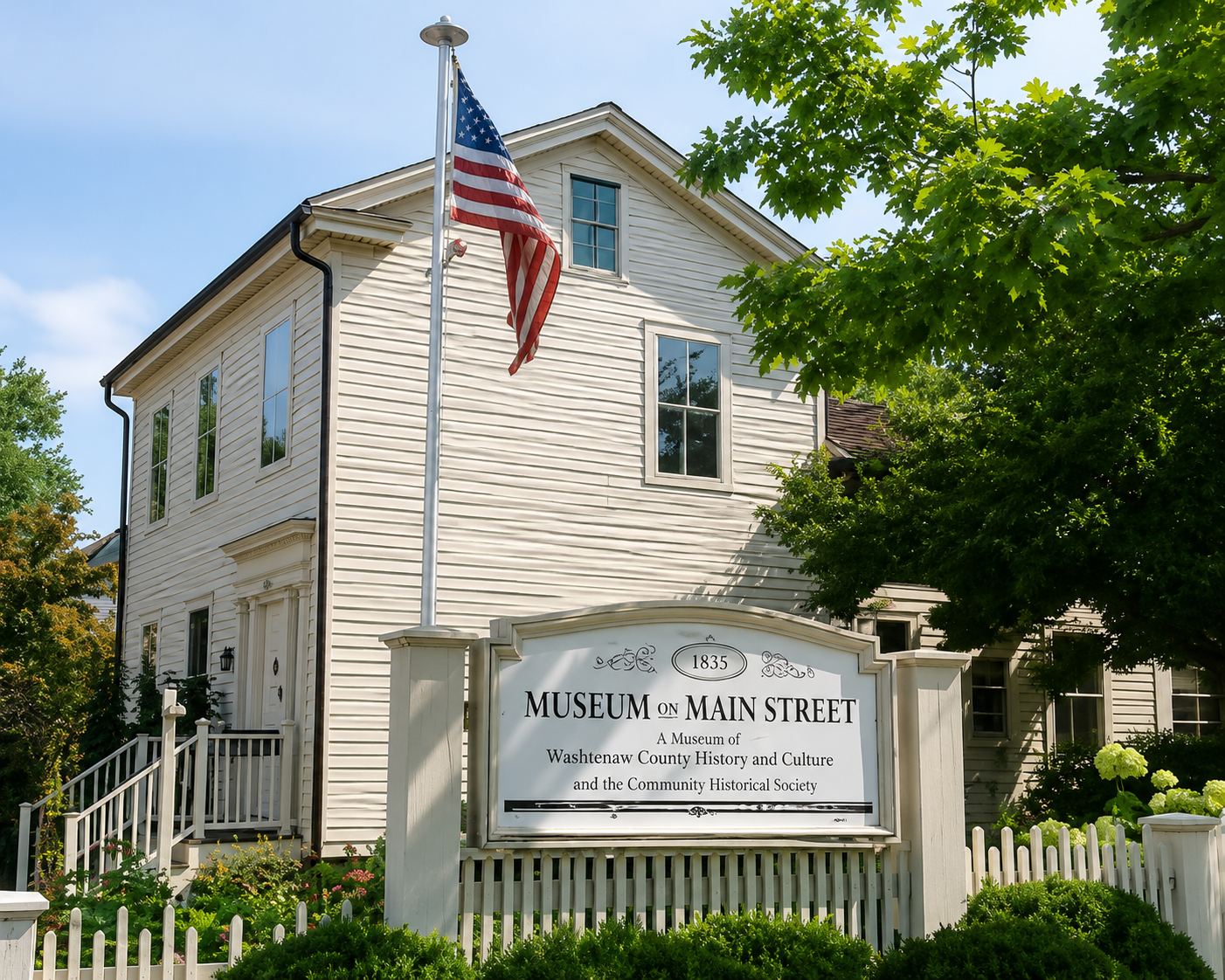
The oldest existing building in Ann Arbor was built in 1835. Its current location at the five points of Main, Kingsley and Beakes streets, and now houses the Museum on Main. Take a look inside and you’ll find a treasure trove of early Washtenaw County history and more in the archives.
Beverly Willis, a historian with the Museum on Main, estimates that “about 3%” of the materials in that museum come from the years before the county’s lifetime as an entity independent of the county centered around Detroit, and quite a bit comes from the period surrounding the county’s creation and aftermath.
“We have John Allen’s lawbooks, a Bible that belonged to Ann Allen, and quite a lot of history of the county,” Willis said.

Washtenaw County Takes shape
The Washtenaw County website notes that it was Sept. 10, 1822, when the Michigan Legislative Council — the precursor to the modern Michigan Legislature — established Washtenaw County. The first European settlement was made near Ypsilanti. Because it was an easy area to ford, it was also a place where Native American villages had existed for centuries.
First Peoples of Washtenaw
The Anishinaabe peoples who originally inhabited what would become Washtenaw County lived side by side with European settlers for a time. But the federal government’s policy of westward expansion eventually led to the 1807 Treaty of Detroit. This led to forced removal, although some managed to stay for a considerable period of time or return afterward, including into the 1820s.
As the City of Ann Arbor puts it, “the Odawa (Ottawa), the Ojibwe (Chippewa), and the Potawatomi (Bodewadmi) and the Wyandotte (Wyandot) — who are part of the Huron tribe — were forced to formally cede (relinquish) their lands in southeast Michigan and northwest Ohio. Other nations who walked these lands and possibly considered them their traditional territories too include the Sauk, Fox, and Kickapoo nations and the Miami people.
“An indigenous-led mapping of traditional territories of tribal nations illustrates the overlapping and multiple nature of the land that became Ann Arbor. Though large numbers of Native people were displaced in the 1800s and brutally removed from their traditional territories, these Native nations and tribes are still alive today. Through their descendants, these Native peoples live on.”

Allen and Rumsey Build a County Seat
Allen was key not just to Washtenaw County’s development but to the centrality of Ann Arbor as well. The University of Michigan’s account of the man suggests he was likely running away from financial disaster when he moved from his native Virginia in 1823. He met Elisha Rumsey, a short-lived co-founder of the area, in 1824, according to U-M. They soon purchased land where Ann Arbor would be.
According to U-M, “both men had the foresight to lobby for and purchase the right to have their village designated the county seat. They paid $1,000.00 for this privilege. The move to obtain the county seat was brilliant foresight on their part because these government institutions, such as the county courthouse and jail, ensured the success of the small village.
“It appears that John Allen was a man of distinct ambition and enthusiasm. Many people attribute a large part of Ann Arbor’s early success to his tireless efforts building up the town structurally and culturally.”

Farms, Mills and Early Growth
The primary attraction for European farmers from the East Coast was farmland. While places like Dexter, Chelsea, Saline and Milan were very much founded as farming towns, it shouldn’t be forgotten that Ann Arbor was also a farming town originally. Like Dexter, Ann Arbor was founded in and around a lumber mill, an early part of the town’s economy and reason for being.
The University of Michigan was established in Detroit in 1817 and was given permission to relocate to Ann Arbor in 1837. The land for the university was provided free of charge.

Laying the Foundations of County Government
By 1827, Washtenaw County had a school, John Allen was the head of the county’s first post office, and Michigan Avenue had been formally surveyed, following essentially the same route as an old Native American trail.
According to the county, “On January 1, Washtenaw County, Territory of Michigan, legally came into being. Division of the County into 20 townships began later that year. The population was nearly 1,000. The first session of County Court was held in the home of Erastus Priest by Samuel W. Dexter, Chief Justice, and by Oliver Whitmore, Associate Justice. The Legislative Council approved the first Circuit Court on April 13, and a Probate Judge was appointed.”
Later this year, visitors will be able to get up close and personal with history at the Museum on Main exhibit “Washtenaw County Bicentennial Beginnings: 200 Years – 20 Townships – One County.” It will open in October.
“From their historical roots to the present, twenty townships are foundational to Washtenaw County’s growth and development. As the County marks its Bicentennial in 2026, this exhibit highlights early Washtenaw beginnings through the sections of land — six miles square — called townships. This family-friendly experience is full of stories, facts, maps, photographs, objects, artifacts and some interactive fun,” Willis said.
Featured image: Museum on Main in Ann Arbor preserves artifacts and records from Washtenaw County’s past and will host a bicentennial exhibit later this year. Courtesy of Museum on Main.












 114 North Main St Suite 10 Chelsea, MI 48118