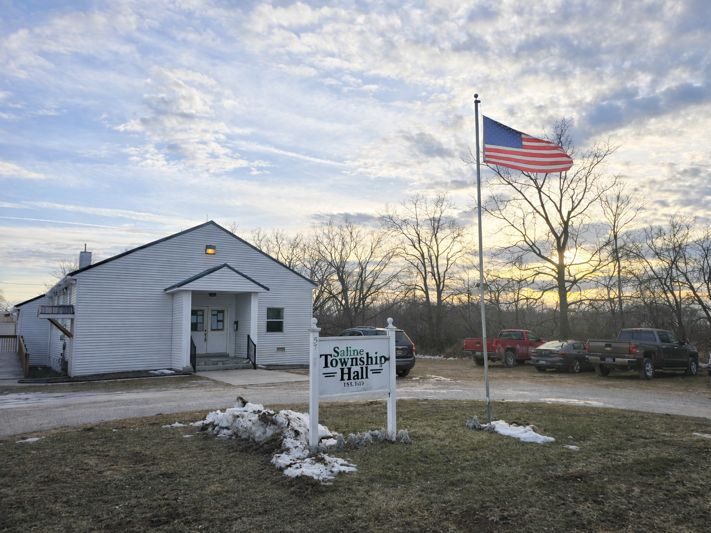
Photo: Saline Township Hall is pictured at dusk, where township officials have faced months of public meetings, legal pressure, and intense scrutiny surrounding the proposed data center and the decision to approve it with conditions as part of a lawsuit settlement. Photo by Doug Marrin
Editor’s note: Public opposition to the proposed data center has been strong, and many residents have shared their concerns in meetings, letters, and public comment. This article does not argue for or against the project. Its purpose is to present the perspective of Saline Township officials who were directly involved in the process, particularly after a lawsuit shaped the options available to the township. Their views are offered to add context to a complex and emotionally charged issue, not to replace or diminish community voices.
For months, Saline Township officials have sat at the center of a storm they say they never sought out. They describe an experience marked by long meetings, legal pressure, angry emails, sleepless nights, and a growing sense that no decision, no matter how carefully weighed, would leave the community whole.
“It just suddenly came to the township,” said township attorney Fred Lucas, describing the first moment the proposal appeared on the board’s agenda. According to Lucas, there had been no outreach, no advance discussions, and no expressed interest by the township in recruiting a data center. “We had no interest in a data center. We weren’t looking for a data center.”
What followed, township officials say, was a rapid escalation from a zoning request into a lawsuit that fundamentally altered the decision-making landscape.
From zoning request to lawsuit
The proposal arrived in mid-summer. By July, the developer had formally applied for a conditional rezoning, an option under state law that allows an applicant to limit a rezoning to a specific use and attach enforceable conditions. In this case, the use was a data center, and the conditions were meant to restrict how it would operate.
The process moved through the standard channels. The Planning Commission reviewed the application, held a public hearing, and rejected it. The Township Board then took it up and also voted it down, 4–1.
Only after that rejection, officials say, did the lawsuit arrive.
“Two days later, we were sued,” Clerk Kelly Marion said, recalling the moment the board realized the issue had entered a new phase.
For Lucas, the lawsuit changed everything. Once litigation began, the board was no longer deciding in a vacuum of policy preference or public sentiment alone. Instead, it was weighing legal exposure, financial risk for the township, and outcomes that could not be fully controlled.
The closed session misunderstanding
One of the most persistent accusations leveled at the board has been that the decision to approve the project with conditions was made in secret. Lucas pushed back strongly on that characterization.
“Contrary to what is set forth in the lawsuit papers, it was never a decision made in closed session,” he said. Closed sessions, he explained, were used to receive legal advice, what the law allows and requires, not to vote or decide.
Dave Landry was present to consult. Landry is a Michigan municipal attorney who specializes in land-use, zoning, and local-government litigation. In the Saline Township data center matter, he was brought in as outside legal counsel after the township was sued, not as a decision-maker, but as a risk-assessment and litigation specialist.
“All that was done in closed session was that Dave [Landry] discussed the pros and cons of this matter… what could happen if we settle, what could happen if we don’t,” explained Lucas.
The final authorization to pursue a settlement, Lucas emphasized, was made openly by the board.
Land that wasn’t going back to farming
A central part of the board’s internal discussion, according to Lucas, was the future of the land itself.
The property in question was zoned agricultural, but that zoning did not guarantee it would remain farmland. Lucas said the landowners had already withdrawn the parcel from the state’s PA 116 farmland preservation program, a move that typically signals an end to agricultural use.
“What does that tell you?” Lucas asked rhetorically. “It tells you they have no intention of farming it anymore.”
In the board’s view, rejecting the data center did not mean preserving open farmland indefinitely. Residential development, Lucas said, was a realistic alternative, one that would bring more traffic, more daily activity, and less revenue than a data center.
“We knew this land was not going to be farmed,” he emphasized.
The risks officials say the public never saw
As the lawsuit unfolded, the township brought in Landry to evaluate the risks. What they heard, board members say, was sobering.
Lucas outlined several scenarios that were discussed with the board, none of which he described as clean or risk-free. Among the most concerning was the possibility of an exclusionary zoning claim, a legal argument that a municipality has unlawfully blocked a legitimate land use.
Another scenario involved the potential loss of zoning authority altogether. Lucas explained that certain entities, such as public universities, are not subject to local zoning. If the original private tenant walked away, he said, the developer could have sought a partnership with a public institution.
“That means we’d still have a data center,” Lucas said, “We get no taxes, and we have no control on the site.”
From the board’s perspective, the settlement, however unpopular, preserved some local oversight.
Conditions as damage control
Much of the settlement’s language focused on limiting impacts that residents had raised repeatedly: water use, noise, and environmental harm.
Lucas said the township rejected water-cooled systems and required a closed-loop design to minimize groundwater use. “The only water that they will use will be for bathrooms, hand washing, and landscaping,” he said.
Monitoring wells were also required. Lucas explained. “If anybody lost a well, they would have to replace it.”
Noise limits were another focal point. The consent judgment caps sound at 55 decibels at the property line. “That’s as loud as you and I talking right now,” Lucas said.
Township engineer Dan Cabage explained that many permits residents were worried about fall under state or county jurisdiction, not the township’s. “MDOT owns that road,” Cabage said, explaining why some traffic and access decisions were beyond local control.
The emotional fallout
While legal risk dominated the board’s analysis, the personal impact came afterward.
Clerk Kelly Marion described months of phone calls, emails, and online accusations. “We’ve been called communists, that power has gone to our heads and that we’re being paid off,” she said.
Lucas bristled at those claims. “They’re accusing this board of a crime,” he said. “That’s bribery, and not one single board member is going to profit in any way, shape, or form from this data center.” Lucas added that such accusations could be defamatory, and those defamed could authorize a lawsuit.
Trustees said the criticism cut especially deep because many of them have lived in Saline Township their entire lives.
“They think we hate the township,” Trustee Dean Marion said. “And we’ve lived here our whole lives, farmed here our whole lives.”
A decision without applause
More than one township official describes it as a no-win situation.
“If we’d have fought in court and lost, we’d have had to raise taxes,” Trustee Tom Hammond said. Insurance coverage for zoning litigation, Lucas added, was limited to $500,000, and that included legal fees which could add up to the hundreds of thousands leaving little to go toward a multi-million-dollar settlement.
Looking back, several trustees said they believe the board did exactly what residents initially asked, voting no on the rezoning, only to face litigation anyway.
“This board did exactly what these residents wanted,” Kelly Marion said.
Living with the aftermath
Now, with construction underway and tensions still raw, township officials say they are trying to move forward without expecting reconciliation.
“I don’t think we’re ever going to see light with these people who think we wanted this,” Kelly Marion said.
Lucas took a broader view, arguing that the conflict reflects a wider trend in local governance. “Everybody wants the benefits of a data center,” he said. “They just don’t want the infrastructure necessary to support those things near them.”
For now, the board remains in office, the project is moving forward, and the community remains divided. Whether the township eventually sees the data center as a manageable neighbor or a lasting scar is a question time will answer.
What is clear, at least from the inside, is that the decision was not experienced as a victory.
When Longtime Residents Are Forced into No-Win Choices
Lucas said there was one final point he wanted people to understand. “Whatever anger or suspicion now surrounds the decision,” he said, “it misses something essential about the people who made it. These were not officials chasing some outside agenda. They are lifelong residents who raised families here, worked the land, and built their lives in Saline Township.” From Lucas’s perspective, the board did not see the settlement as a victory or endorsement of the project, but as an attempt to limit harm in a situation that had already narrowed to bad options. The decision, he said, was not about wanting a data center. It was about choosing what they believed was the least damaging path forward when every alternative carried real consequences.




 8123 Main St Suite 200 Dexter, MI 48130