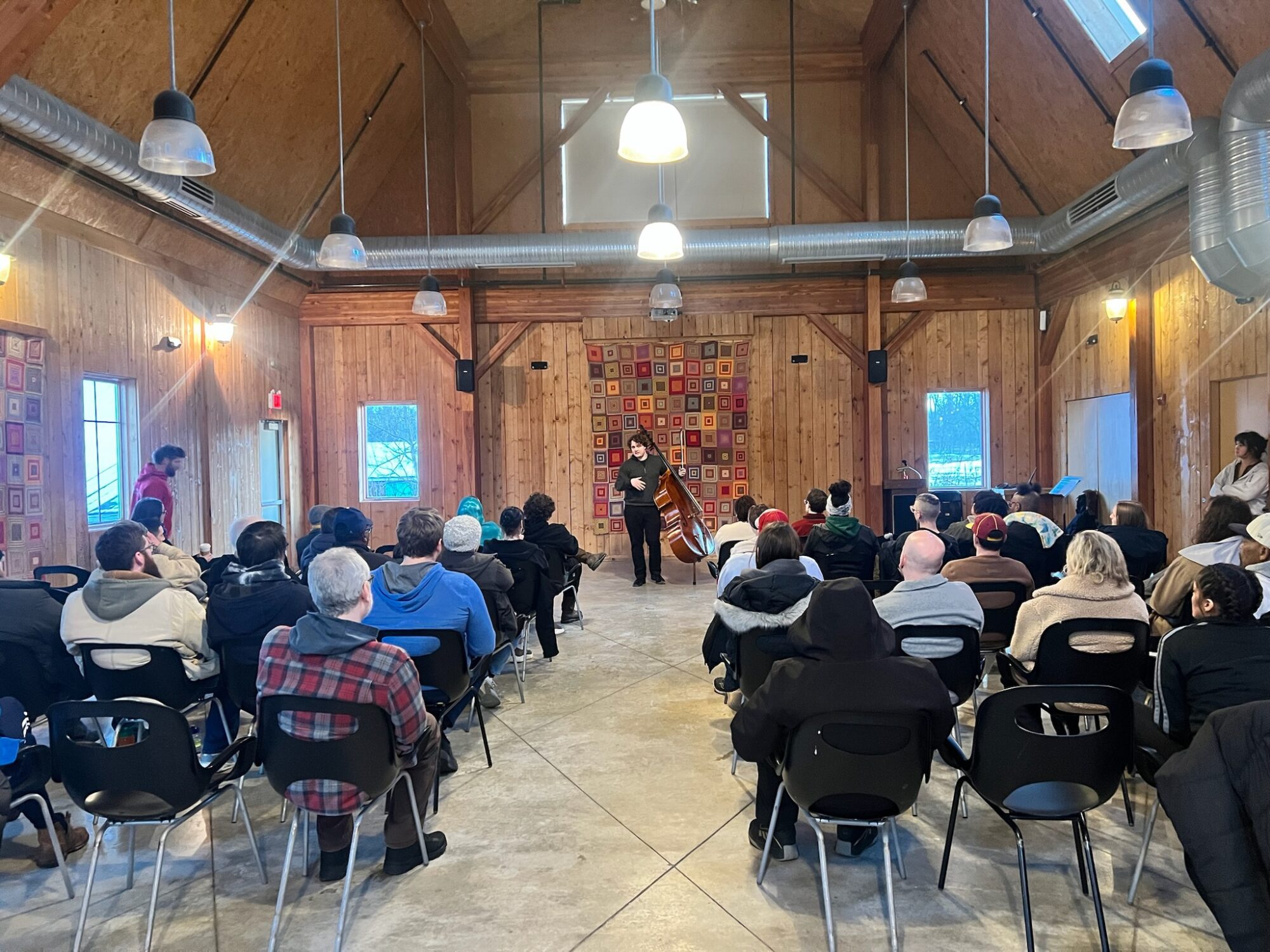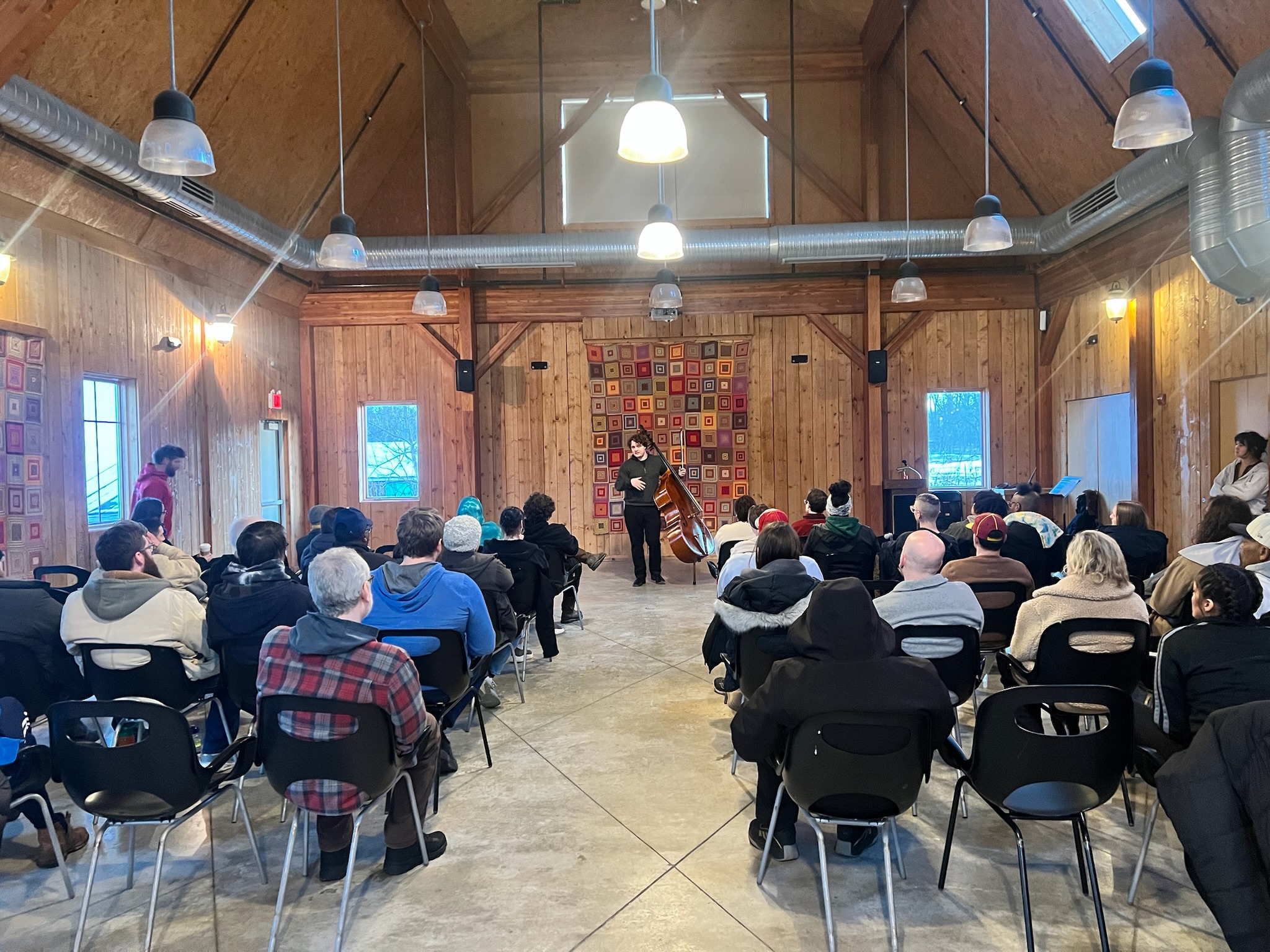





When musicians from Unison Chamber Music Collective enter a shelter, recovery center or correctional facility, they come not only to perform, but to share music with the people gathered there.
Founder Allyson Cohen said everyone in the room helps shape what follows.
“Everyone in the room is an equal participant,” Cohen said. “The music is a conduit. We’re all just people.”
That belief guides the southeast Michigan nonprofit, which brings free chamber music programs to shelters, recovery centers and correctional facilities. Each experience is built around conversation, participation and human connection.
Unison returns monthly to six facilities, including the Shelter Association of Washtenaw County, Dawn Farm Recovery Center, Salvation Army Harbor Light, Women’s Huron Valley Correctional Facility, the Federal Correctional Institution in Milan and Alpha House. It presents more than 50 free, engagement-based performances each year.
For Cohen, however, the work is not primarily about the number of performances.
“Community building doesn’t happen in a day,” she said.

Everyone Belongs in the Room
At a Unison program, musicians may introduce a piece, invite listeners to share what it brings to mind or ask about music that has mattered in their lives.
The goal is not to simplify classical music or tell people how to appreciate it. It is to remove the expectations that can make concert halls feel intimidating.
People may worry about what to wear, when to clap or whether they know enough to belong, Cohen said.
Unison instead creates room for conversation and shared experience. The musicians may arrive holding the instruments, but Cohen said that does not make them more important than anyone else there.
“No one is better or worse than me,” she said. “We’re all joining one another in that moment.”
During a collaboration with a prison choir, Cohen learned that singing was one of the things helping some members make it through their days.
The choir’s director, who is incarcerated, told her how much the music meant to the group. Some of the men had gone years without hearing songs they loved, she said.
The experience reinforced Cohen’s belief that music can offer comfort and preserve a sense of identity, even in a place where much of a person’s independence has been taken away.
“No matter what, the music will never let you down,” Cohen said. “The music is a friend to you.”
At shelters, smaller groups give Cohen and the musicians time to learn people’s names, hear their stories and remember the music they enjoy.
Over time, the musicians are no longer entering an unfamiliar facility. They are returning to people they know.
Some people Cohen met through Unison’s shelter programs were later bused to attend her master’s ceremony at the University of Michigan.
“These are people I feel so integrated into the community with,” she said.
For Cohen, that relationship shows the difference between a single outreach event and sustained community building.
“We have to make systematic change, especially when we’re talking about community building, because community building doesn’t happen in a day,” she said.
Cohen would like to expand Unison’s work throughout the Midwest and eventually beyond, but not at a pace that sacrifices the individual relationships at its center.

A Different Kind of Success
Cohen founded Unison in 2022 after reconsidering what she wanted her life as a professional violinist to look like.
“I don’t know who I would be if I wasn’t a musician,” she said. “My love of the music is what keeps me going.”
Like many young classical musicians, Cohen learned to measure progress through auditions, technical improvement and prestigious opportunities. She performed at Carnegie Hall and Philadelphia’s Kimmel Center and worked as a substitute violinist with the Philadelphia Orchestra.
Those experiences were meaningful, she said, but they also reflected the version of success she had been taught to pursue.
“You’re just told that you need to be great and that whatever you’re doing is probably never enough,” Cohen said.
Young musicians may spend years preparing for the next audition without much guidance about how to build a sustainable career or find meaning in their work, she said.
Cohen had reached opportunities she once considered the goal, but she still wanted a stronger connection between her music and the people hearing it.
“I don’t think it’s a certain outcome that makes us happy or fulfilled as artists,” she said. “I think we have to find meaning in the work itself.”
She began cold-calling community organizations and offering performances. The initial idea was to expand access to classical music.
As she spent more time in shelters and correctional facilities, the mission evolved. The work became less about bringing something to a community and more about creating something with the people already there.
For Cohen, that gave her career what she calls a “kinder why.”
“I want to be an artist that brings people together,” she said.

Training Musicians to Listen
Through a partnership with the U-M School of Music, Theatre & Dance, Unison also trains student chamber ensembles to perform at its partner facilities.
Students receive mentorship and learn engagement-based and trauma-informed practices alongside their musical preparation. The programs emphasize empathy, flexibility and meaningful connection with the people sharing the experience.
Cohen said conservatory culture can push musicians toward perfection through fear of failure. Students may practice because they are afraid of disappointing a teacher, losing an opportunity or falling behind.
Unison offers another reason to improve: preparing for an experience in which someone feels welcomed and heard.
The work also requires skills that cannot be developed alone in a practice room. Musicians must listen, read the room and adapt when a program unfolds differently than expected.
Technical excellence still matters, Cohen said, but it becomes part of a broader responsibility to the people sharing the space.
Unison received the U-M EXCEL Prize for social impact and arts entrepreneurship. Cohen plans to begin doctoral studies in violin performance at Stony Brook University while continuing to lead the organization.
She hopes Unison can help musicians think differently about who classical music belongs to and what it means to serve a community without speaking down to it.
“People don’t become homeless because they run out of things, but because they run out of people,” Cohen said.
Music cannot replace housing, treatment, safety or other material needs. But it can create a space where people are not reduced to what they lack or what they have endured.
They can listen, speak, remember and take part.
“We’re all just people,” Cohen said.
Photos courtesy of Unison Chamber Music Collective






 114 North Main St Suite 10 Chelsea, MI 48118