




Editor’s Note: As the nation marks its 250th anniversary, the Dexter Area Historical Society presents a series exploring Dexter’s history within the broader context of state and national events. This second installment looks at Michigan’s path to statehood.
Michigan’s quest for statehood took over four years due to a bitter border dispute with the state of Ohio. In October of 1832, Michigan citizens voted to petition for statehood, but it was not officially granted until January of 1837.
Michigan was part of the Northwest Territory, which was created in 1787 by the Confederation Congress, which governed the country prior to the adoption of the US Constitution. The law was called “An Ordinance for the Government of the Territory of the United States North-West of the River Ohio” and described how the western lands acquired from Great Britain after the American Revolution were to be managed.
The Ordinance chartered a government for the territory and a method for including new states into the union. It contained key provisions for the territory, including the prohibition of slavery in the new states and provisions for fair treatment of the Native Americans. It also included verbiage regarding boundaries of states carved out of the territory and specified that an east/west line drawn from the southernmost end of Lake Michigan toward Lake Erie as the southern boundary of any state or states formed in the northern portion of the territory.

However, Ohio was granted statehood in 1803 with a state constitution that specified its northern border as follows: “with the assent of Congress of the United States, the northern boundary of this State shall be established by and extended to a direct line running from the southern extremity of Lake Michigan to the most northerly cape of the Miami Bay.” (Note: Historically, the river was known as the Miami. It was later anglicized to Maumee.)
This encroached upon land belonging to Michigan and created a disputed area known as the “Toledo Strip”. Ohio wanted to control the Maumee River as it was critical to its canal system from the Ohio River to Lake Erie and so moved its border north to include the mouth of the Maumee. Since Congress accepted the Ohio petition for statehood, Ohio claimed that Congress agreed to their border and the land was theirs. However, residents of the area had been under Michigan rule, had paid taxes to Michigan and used Michigan laws and courts and considered themselves Michigan citizens. Michigan was not about to give up that stretch of land.

When Indiana was granted statehood in 1816, it, too, placed its northern border north of the line specified in the Northwest Ordinance to gain frontage on Lake Michigan. This move was uncontested by Michigan’s territorial government, as the area was wilderness and poorly settled.
The border disagreement with Ohio erupted into the Toledo War in 1835. Several skirmishes occurred during that summer, with Dexter men led by A. D. Crane taking part. Other than pillaging, fires and a small knife wound suffered by a Michigan sheriff, there were no casualties and no resolution. The dispute continued in Congress.

At the same time, Michigan held a constitutional convention, which included Dexter delegates Nathaniel Noble, Rufus Crossman, and Nelson Wing. The convention drafted a constitution and set up a government, which was a prerequisite to statehood.
The border dispute was debated in Congress, where Michigan had few supporters aside from Massachusetts Representative John Quincy Adams, who stated:
“Never in the course of my life have I known a controversy of which all the right was so clearly on one side, and all the power so overwhelmingly on the other; never a case where the temptation was so intense to take the strongest side, and the duty of taking the weakest so thankless.”

Ohio was a state and had voting rights in Congress, while Michigan, as a territory, could only observe. Ohio’s electoral votes were considered critical in the election of 1836. President Jackson did not want to risk losing their support for his hand-picked successor, Martin Van Buren.
In the end, Congress agreed to grant statehood to Michigan if and only if it accepted a compromise — Michigan would be given the Upper Peninsula and, in turn, would give up the Toledo Strip. The offer was roundly defeated by the Convention of Assent held in Ann Arbor in September of 1836. However, the need for federal funds and the realization that the cause was lost, convinced the second Convention of Assent held in Detroit to approve the compromise in December with statehood granted in January of 1837.
It is said that the Toledo War was the origin of the designation Wolverines. Ohioans used it as a derogatory term but Michiganders were proud to be associated with the fierce and courageous animal.
While Michigan was struggling to define its border and join the union:
- The first emigrant train traveled the Oregon Trail in 1836
- Texas was battling for independence from Mexico and the battle of the Alamo was fought in February and March of 1836
- The Indian Removal Act of 1830 led to the evacuation of Native Americans from the Southeast in what is known as the Trail of Tears
- In 1831 Cyrus McCormick invented the mechanical reaper which replaced manual scythes and increased farm production more than twenty-fold. This resulted in a massive expansion in Midwest farming and is considered one of the most important 19th-century agricultural inventions. Cyrus catapulted his invention to a successful business which became International Harvester. His daughter-in-law Katharine Dexter McCormick inherited a portion of the family wealth through her husband Stanley McCormick. Katharine’s need to lessen the resulting tax burden led to the donation of Dexter’s Gordon Hall to the University of Michigan.
For an excellent, detailed account of Michigan’s quest for statehood and the border war with Ohio, see: The Toledo War: The First Michigan-Ohio Rivalry by Don Faber.
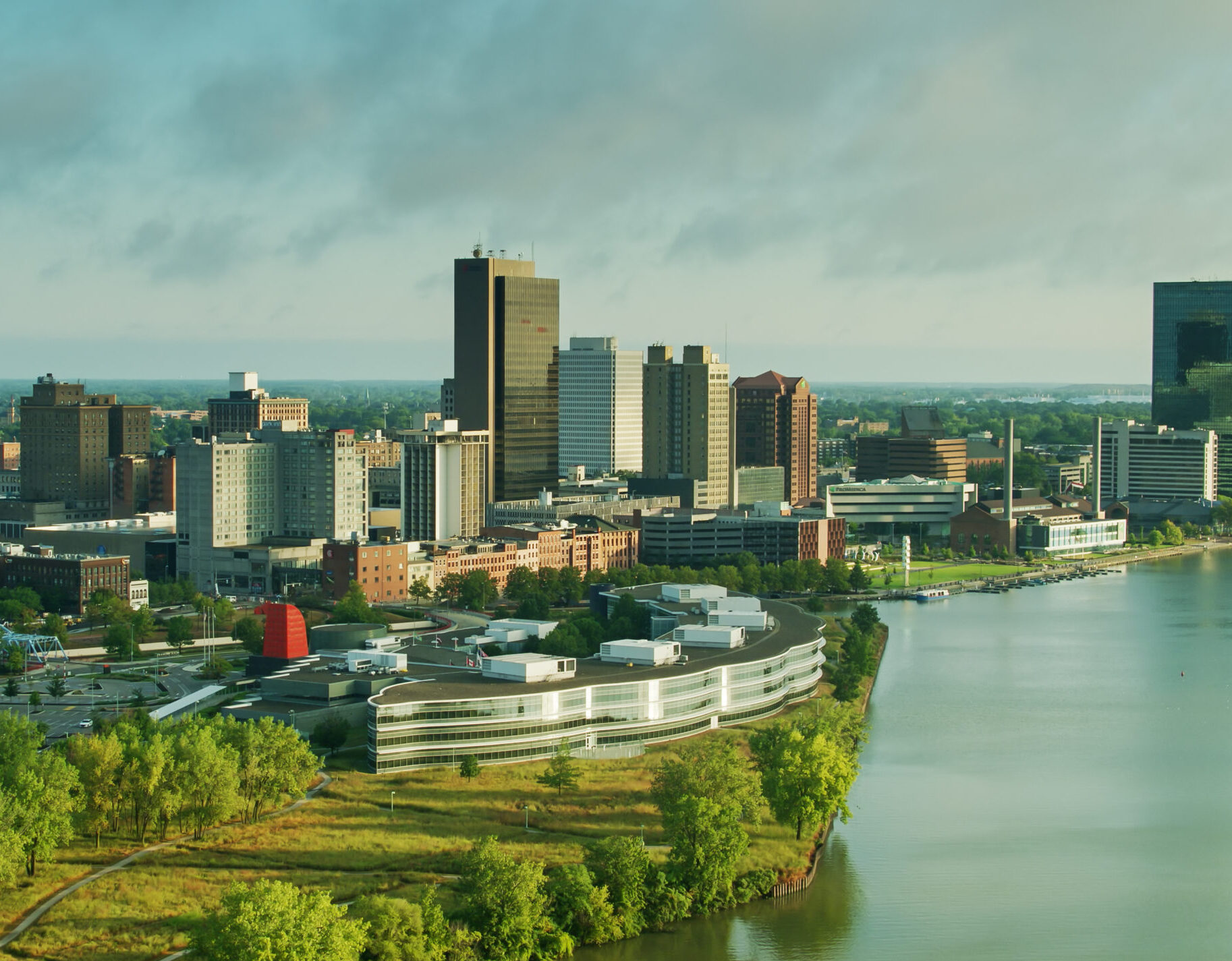
Featured photo: Aerial shot of Toledo, Ohio, taking in the downtown on the banks of the Maumee River. Photo by Hal Bergman










 114 North Main St Suite 10 Chelsea, MI 48118