



Before Michigan became famous for roadside sugar shacks and amber bottles lining grocery shelves, the sweetness of maple flowed through the forests as a sacred gift. Long before statehood, long before settlers arrived, native families gathered beneath towering maples at winter’s edge, reading the trees the way others read calendars.
What many today see as a breakfast staple began as something far deeper, a seasonal ceremony, a survival skill, and a spiritual teaching rooted in the Anishinaabe understanding of balance between people and the land.
When Spring Meant Sugar
As winter loosened its grip on the forests of Michigan, Anishinaabe families watched for a subtle but powerful sign: freezing nights followed by warming days. That rhythm signaled the arrival of Ziigwan, spring, and with it, the flowing of life-giving sap from the Aninaatig, the maple tree.
Long before Michigan became known for commercial syrup production, Native communities were gathering in maple groves to practice a tradition both practical and sacred. Today’s maple syrup industry across the Great Lakes owes its origins to the knowledge, labor and ecological wisdom of the Anishinaabeg, including the Ojibwe, Odawa and Potawatomi peoples, who developed and refined the art of maple sugaring centuries ago.


The Seasonal Move to the Sugar Bush
For Indigenous families, maple sugaring was not a quick chore. It was a seasonal migration and community event.
In late winter, families left their dispersed winter hunting camps and traveled to maple groves known today as “sugar bushes.” There, they established temporary sugar camps where multiple generations worked side by side.
The harvest had deep spiritual connotations, marking more than a change in weather. It represented renewal, ceremony and survival.
Maple sugar, known in Ojibwe as Ziinzibaakwad, literally “drawn from the wood,” was a vital source of calories after long winters. It could be stored, traded and used to flavor foods year-round. Unlike liquid syrup, granulated maple sugar was portable and durable, making it especially valuable.

Tapping the Aninaatig
The science of maple sugaring was rooted in careful observation of nature.
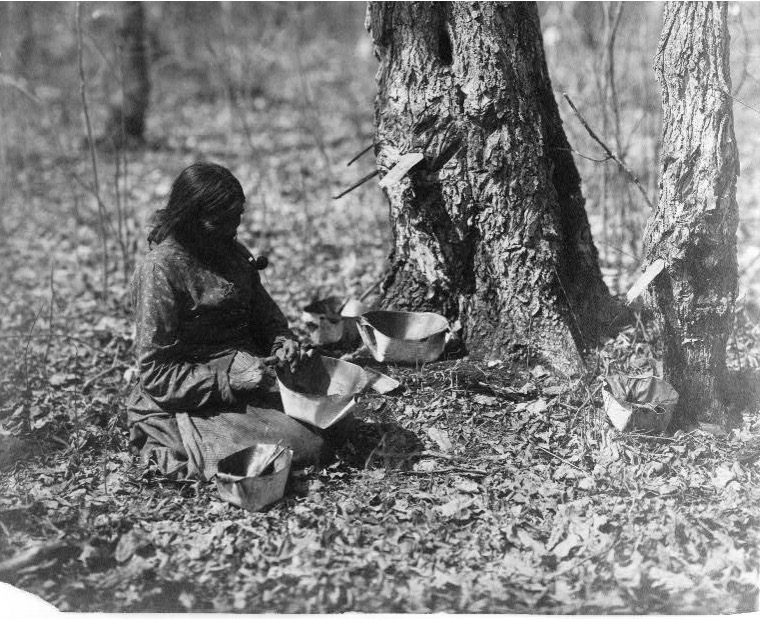
When sap began to flow, harvesters made small incisions into maple trunks using wooden or stone tools. Sap was collected in birch bark containers or hollowed wooden troughs placed beneath the cut.
Without modern metal kettles, early processors relied on ingenuity. One common method involved heating stones in Ishkode, fire in Anishinaabemowin, and dropping the hot stones directly into sap-filled containers. The intense heat evaporated water, slowly concentrating the sugars.
Another technique took advantage of Michigan’s fluctuating temperatures. Sap was left to partially freeze overnight. Because water freezes before sugar, ice could be removed, naturally concentrating the liquid before boiling even began.

A Sacred Gift, Not Just a Sweetener
Within Ojibwe tradition, maple sugar carries spiritual meaning.
According to oral histories, the Creator originally made maple sap far sweeter, flowing like syrup directly from the tree. But people became complacent. To teach gratitude and responsibility, the sap was thinned, requiring effort to transform it into sugar. The lesson was that nothing valuable comes without work and respect.
Because of this belief, maple sugar is treated as a gift. If it was spilled or wasted, offerings such as tobacco were traditionally given in acknowledgment.

Trade, Colonization
When European settlers arrived in the Great Lakes region in the 17th and 18th centuries, they encountered well-established Indigenous sugaring camps. Colonists quickly adopted the practice.
Through trade, metal kettles replaced stone-heating methods, making boiling more efficient. Later innovations introduced flat pans and enclosed “sugar shacks.” While technologies evolved, the foundational knowledge, when to tap, how to care for trees, how to boil sap, came from Indigenous communities.
Treaty Rights and Modern Revitalization
Today, several Michigan tribes continue to exercise treaty rights that protect traditional gathering practices, including maple sugaring on certain public lands.
Cultural revitalization efforts are also reconnecting younger generations to the sugar bush. Projects like Detroit’s Indigenous-led maple programs and tribal community events across northern Michigan are re-centering maple sugaring as both cultural education and environmental stewardship.
Each spring, when the nights dip below freezing and the days thaw, families once again gather beneath tall maples. Buckets fill. Steam rises. Stories are told.
And the sweet scent of boiling sap carries forward a tradition that predates the state itself.
More Than Syrup
Michigan is now one of the top maple-producing states in the nation. But behind every bottle lies a deeper story, one of Indigenous innovation, resilience and reverence for the forest.
What many see as pancake topping began as Ziinzibaakwad, drawn carefully from the wood, with gratitude and skill.
As spring returns each year, so does a reminder that Michigan’s maple legacy flows from Native roots.
Why the Sap Runs Thin: The Story of NenawBozhoo
Long ago, when the world was still young and the people were learning how to live upon it, the maple trees did not give sap as they do today.
In those days, according to the Chippewa (Ojibwe) and Ottawa peoples of Michigan, the trees flowed with nearly pure syrup. There was no need to gather wood, no need to tend a fire, no need to boil and wait. The sweet gift poured easily from the trunks.
Watching over the people was NenawBozhoo, known in many Anishinaabe traditions as a powerful spirit, teacher and trickster. He loved his people deeply. But he also understood something essential about human nature: when life becomes too easy, people can forget gratitude. They can grow idle. They can lose balance.
Seeing the syrup flow so freely, NenawBozhoo worried. If sweetness required no effort, he feared the people would grow indolent, dependent on abundance without labor, and in time lose the strength and discipline needed to survive.
So he cast a spell upon the sugar maple.
From that moment forward, the thick syrup thinned into what we now call sap — clear, watery, and far less sweet. To taste sugar again, the people would have to work for it. They would have to cut wood, build fires, gather sap, and boil it down with patience and care.
NenawBozhoo ensured that sweetness would still be there, but only through effort, cooperation and respect for the gift. In doing so, he bound together work and gratitude, survival and ceremony.
Sources
- Great Lakes Anishinaabe oral histories and Anishinaabemowin language resources
- The Tradition of Maple Sugar Among the Ojibwe by Burt Lake Band
- Maple Sugaring at Mackinac, MackinacParks.com
- The History of Maple Syrup, Michigan Maple Syrup Association
- Activists tap a sweet Indigenous tradition to connect youth of color in Detroit with the outdoors, PBS.org/newshour
- The Ojibwe People’s Dictionary










 114 North Main St Suite 10 Chelsea, MI 48118