Getting to hear the personal, historical account from a survivor of the Holocaust, Dexter High School (DHS) students were paid a special visit from Irene Hasenberg Butter on December 9. Butter’s talk gave students both an insight into a difficult and important time in world history as well as a chance to hear a unique story from which they might find even more motivation to stand up against hatred, prejudice and racism.
After years of remaining silent about her story, she said it was her duty to now tell it and in turn hopefully help others to remember the lessons from that time. Of her being a survivor while also encouraging the students that one person can make a difference and exhorting them to not just stand by when others might be in need or trouble, Butter’s talk was a memorable one.

A Talk with Students at DHS
The personal visit by Dr. Butter came about through the efforts of DHS teacher Jaime Dudash, who received a grant from the Irene Butter Fund that was established by the Jewish Federation of Greater Ann Arbor. Students filled into DHS’s Center for Performing Arts to hear and see Butter’s presentation.
Her story is founded in her being a Holocaust Survivor who now spends her life in service to peace.
Butter is a professor emeritus from the University of Michigan and one of the first women to earn a Ph. D. from Duke University in the field of economics. Her peace work and service includes helping to organize the recognition of the Raoul Wallenberg Medal and lecture series for outstanding humanitarian work given annually at the University of Michigan, and building bridges and dialogues between women of the Jewish and Muslim faiths through Zeitouna.
Another big part of her work is giving talks at schools. Butter said her goal with the school talks has been “to transmit lessons I have learned from the Holocaust, to help youth to understand the gravity of genocide, to develop their appreciation of freedom, and human rights, and to motivate them to stand up against hatred, prejudice, and racism.”
Her life and journey
Butter was born Irene Hasenberg in 1930, and lived in Berlin with her father, mother and brother. She said for the first six years of her life things were going well, but that started to change when the Nazis took power and began persecuting Jewish people, which included the Nazis taking away the bank her family owned and operated.
They decided to move to the Netherlands in 1937 after her father found a new job there with American Express in Amsterdam. This was where Anne Frank’s family fled to as well. Butter said they thought they had gotten far enough away from the Nazis, but again that changed when Germany invaded in 1940.

This was when the Nazis again brought their oppression upon them and others.
It was in Amsterdam when she and other Jews saw their rights growing even more restricted and when they began hearing about Jews being rounded up and sent to camps. As things grew worse in 1943, she said her father began working toward another way to escape, which included working to get them passports to Ecuador.
Then things took another concerning turn in 1943, when she and her family and others were rounded up and sent to Camp Westerbork in the Netherlands, which was a transit camp and stopover for Dutch Jews before being sent to extermination camps. Butter said it wasn’t an extermination camp, but it was a difficult time. It was at this camp, she said, when the names of those being sent to extermination camps would be read aloud each week. However, it was also in this camp when they received their Ecuadorian passports.
They were allowed to get one package while at Westerbork, she said, and this was what her father was able to obtain for them in an effort to keep them alive. Butter said the passports didn’t give them freedom yet, but they did give them a different status. With the passports they could be part of a group of Jews/prisoners the Germans would use to trade for German prisoners held by the Allies.
However, that didn’t happen at that time because early in 1944 they were put on a train for Camp Bergen-Belsen in Germany where thousands would die. It was at this camp where they would suffer horrible conditions from lack of food, slave labor and overcrowding. With members of her family growing sicker each day they finally received news that they with their passports would be exchanged for German prisoners and sent away by train to Switzerland.
But before they left the camp her father was severely beaten by the Nazis. He and her mother and brother would all leave the camp in a dire state. Her father would go on to die two days after leaving and was buried in a town in Germany while her brother and mother would arrive in Switzerland and be immediately taken to the hospital because of their bad conditions.
This would separate the family because as they were in the hospital, Butter was made to leave for a refugee camp in Algeria called Camp Jeanne d’Arc. This camp was much different for her and it was a place where she could begin healing even though she was holding onto the tragedy of her father’s death and being sent away from her mother and brother.
As the war ended in 1945, Butter, still in Algeria, would finally have the opportunity to find true freedom when she hitched a ride on an American Liberty ship that was making its way to the U.S. She arrived in Baltimore harbor on Christmas Eve that year and then six months later with them healed up she was reunited with her mother and brother after they made their way to America.
In the U.S., Butter’s life would grow as she focused on a new life, such as getting an education. She would go on to graduate from high school and Queens College in New York City, and then become one of the first women to earn a Ph.D. in economics from Duke University.
She met her husband, Charlie Butter, in college and they would go on to marry, have two children and then become professors at Michigan.
Finding her Voice and Mission
All through those years in the U.S, however, she wouldn’t tell her story. The story of her journey from Germany to America, the story that saw her father die after being beat by Nazis, and the story of her grandparents and Anne Frank being taken away and dying in a concentration camp. She held it all in.
It was years later that she would begin to see her true responsibility as a survivor. It was when her daughter in high school was doing a project on the Holocaust and she would ask her mother for help by telling her story to the class. And then a few years later she was invited to participate on a panel about Anne Frank. She said since Anne Frank was not able to tell her story because her voice was silenced forever, she realized she could and should tell their stories, and help others to understand the importance of remembering and knowing what they endured.
Another inspiration for Butter was Elie Wiesel, who is also a Holocaust survivor, and Nobel Peace Prize winner and global advocate for peace.
“It was my responsibility to tell my story,” she told the Dexter students.
She said she owes it to her father, Anne Frank and everybody who suffered to talk about what she learned because suffering never ends, so the work must continue.
Butter cited a quote from Wiesel that says, “If you were there, if you breathed the air and heard the silence of the dead, you must continue to bear witness…to prevent the dead from dying again.”
Butter asked the students to remember three points: refusing to be enemies, one person can make a difference and never be a bystander. She said they have the abilities to make meaningful change and remembering these things can make all the difference in the world.
To learn more about Butter, go to https://www.irenebutter.com/.

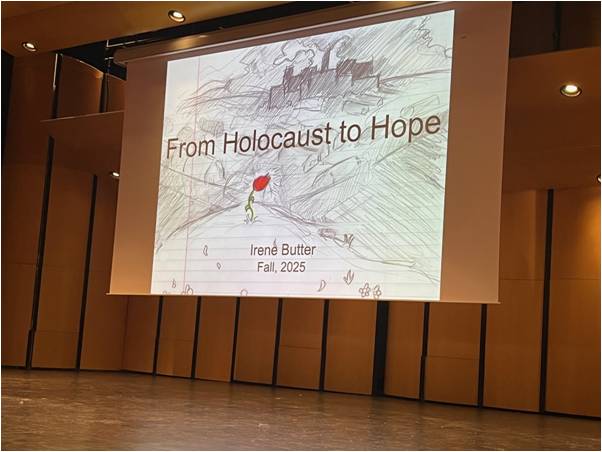
Photo 1: Butter’s presentation begins at DHS. Photo by Lonnie Huhman
Photo 2: Dr. Butter spoke to well over 100 students at DHS on Dec. 9. Photo by Lonnie Huhman
Photo 3: Butter showed a map to detail her journey through the Holocaust. Photo by Lonnie Huhman
Photo 4: Butter giving the students some points to remember. Photo by Lonnie Huhman




 8123 Main St Suite 200 Dexter, MI 48130