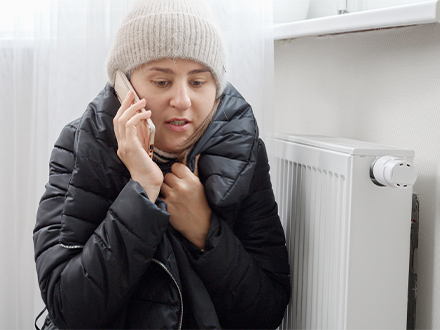
Lost heat on a cold Michigan night? Run through these seven safe checks before you call — several take less than five minutes and cost nothing.
When the furnace quits in the middle of a Michigan cold snap, it’s stressful — but the cause is often something simple you can fix in a few minutes without paying for a service call. Before you call for heat repair, work through these seven checks in order.
One safety rule comes first: if you smell gas or your carbon monoxide alarm sounds, leave the house immediately and call 911 from outside. Don’t troubleshoot, don’t flip switches, and don’t go back in until it’s declared safe.
| Still no heat after the basics? Reach a licensed, insured local HVAC tech 24/7: Call (734) 280-2212 (available 24/7) |
1. Check the thermostat
Start with the most common and most overlooked culprit. Make sure the thermostat is set to HEAT and the target temperature is at least a few degrees above the current room temperature. If the display is blank or dim, replace the batteries — dead batteries stop many thermostats from signaling the furnace at all. If you have a smart thermostat, confirm it hasn’t drifted into an ‘away’ or ‘eco’ schedule.
2. Replace a clogged air filter
A dirty air filter is the single most common cause of furnace problems. It chokes airflow, which makes the furnace overheat and shut itself off on a safety limit — sometimes repeatedly. If your filter is gray and packed with dust, swap in a fresh one and see if the furnace restarts and stays running. During heating season, plan to change the filter every one to three months.
3. Confirm the power switch and breaker
Furnaces have a power switch nearby that looks exactly like an ordinary light switch — and it gets flipped off by accident more often than you’d think, especially if it’s near a basement light. Make sure it’s on. Then check that the furnace’s circuit breaker hasn’t tripped; if it has, reset it once. If it trips again, stop and call a technician.
4. Check the gas supply
For a gas furnace, confirm the gas valve on the supply line is open — the handle runs parallel to the pipe when open and perpendicular when closed. If your other gas appliances (stove, water heater) aren’t working either, the problem may be with the gas supply itself rather than the furnace, and you should contact your gas utility.
5. Make sure vents and registers are open
Walk through the house and confirm the supply and return registers are open and not blocked by furniture, rugs, or boxes. Closing off too many vents restricts airflow and can trip the furnace’s safety limits, causing it to shut down even though nothing is broken.
6. Reset or relight per the owner’s manual
Many furnaces have a reset button, and high-efficiency condensing furnaces have a condensate drain line that can clog and trip a float switch, shutting the unit off to prevent overflow. Check your owner’s manual for the correct reset procedure for your model, and follow only that procedure. If you have an older unit with a standing pilot light that’s gone out, the manual will show the safe relight steps.
7. Check the furnace door or access panel
Most furnaces won’t run unless the front access panel is fully seated, because it presses a small safety interlock switch. If the panel was recently removed — say, to change the filter — make sure it’s back on securely. It’s a surprisingly common reason a furnace won’t start after routine maintenance.
| Want it handled fast? A licensed, insured local HVAC tech is one call away. Call (734) 280-2212 (available 24/7) |
Carbon monoxide and gas safety
Furnaces and other fuel-burning appliances make carbon-monoxide protection essential, especially in winter when the house is sealed up tight.
| Safety: If you smell gas or a carbon-monoxide detector sounds, leave the house immediately and call 911 from outside — don’t relight anything or flip switches. Make sure you have working CO detectors near every sleeping area and test them regularly. A yellow (rather than crisp blue) burner flame or excessive soot around the furnace can signal incomplete combustion and warrants a professional inspection. |
Decode the warning signs
If the furnace is running but something seems off, the symptom can point to the problem:
- Blowing cool air — often the thermostat fan is set to ON instead of AUTO, or the burners aren’t igniting
- Short-cycling (turning on and off repeatedly) — frequently a clogged filter, overheating, or a thermostat issue
- Banging, screeching, or rumbling — can indicate a mechanical or ignition problem; shut it down and call a pro
- A persistent burning or electrical smell — turn the furnace off and call for service
Annual maintenance prevents most no-heat calls
The majority of mid-winter breakdowns trace back to skipped maintenance. A fall tune-up — done before heating season — cleans the burners and flame sensor, checks the igniter and safety controls, inspects the heat exchanger for cracks (a carbon-monoxide hazard), confirms the blower is moving air, and replaces the filter. It costs far less than an emergency call on the coldest night of the year, and a clean, properly tuned furnace runs more efficiently, trimming your winter bills.
What common furnace repairs cost
Costs vary by unit and contractor, but here’s the rough hierarchy to set expectations. A thermostat or filter fix is minor. Igniters, flame sensors and capacitors are common, moderate repairs. A blower motor or control board is a bigger ticket. And a cracked heat exchanger — a safety issue — usually tips the decision toward replacement. If repairs on an aging furnace start stacking up over a season or two, ask your technician for an honest repair-versus-replace assessment rather than paying for one fix after another.
When to call an HVAC pro
If you’ve run through the checks and still have no heat — or the furnace short-cycles, won’t ignite, makes unusual noises, or smells like it’s burning — it’s time for a professional. And if your furnace is 15 to 20 years old and needs a significant repair, it may be worth comparing the cost against a new high-efficiency model; in Washtenaw County, DTE Energy offers rebates for qualifying high-efficiency furnaces. The Sun Times News keeps a 24/7 line to vetted local HVAC techs.
Frequently asked questions
Why is my furnace blowing cold air?
The most common reason is the thermostat fan set to ON instead of AUTO, so it blows even when the burners aren’t firing. It can also signal ignition problems, an overheated unit shutting down the burners, or a clogged filter. If the basics don’t fix it, call a technician.
How often should I change my furnace filter?
Every one to three months during heating season — more often with pets or a dusty home. A clean filter is the cheapest, easiest way to prevent furnace breakdowns and keep your bills down.
Is it safe to reset my furnace myself?
Pressing the reset button once, following the owner’s manual, is generally fine. If it trips again right away, stop and call a technician — repeated tripping means a safety system is doing its job and something needs attention.
Why does my furnace keep shutting off?
Short-cycling is often caused by a clogged air filter, an overheating unit, a blocked flue, or a thermostat problem. Start by replacing the filter and opening vents; if it continues, have it inspected.
How long should a furnace last?
Most gas furnaces last 15 to 20 years with regular maintenance. Past 15 years, weigh the cost of repairs against a more efficient replacement.
Who do I call for furnace repair near Chelsea, Dexter or Saline?
For 24/7 heating help from a licensed local HVAC tech, call (734) 280-2212.
| Comfortable home, fast. Reach a licensed, insured local HVAC tech: Call (734) 280-2212 (available 24/7) |
Last updated June 2026. This guide is general information for Washtenaw County homeowners and isn’t a substitute for professional, safety, or insurance advice. In an emergency, call 911.



 114 North Main St Suite 10 Chelsea, MI 48118