




As summer camps, church programs, clubs and other youth activities continue across Washtenaw County, child safety advocates say prevention can start before drop-off, with direct questions about who is supervising children and what happens when concerns arise.
The questions are timely amid public interest in an active Washtenaw County child sexual abuse case involving Zachary Radcliff, a former youth and music leader at Oakwood Church in Augusta Township. Radcliff is charged with more than 60 felony counts related to alleged child sexual abuse and child sexually abusive activity, according to public reporting on the case. Michigan State Police have said the investigation remains active.
Radcliff has not been convicted, and the allegations remain pending in court. While prevention experts are not being asked to comment on that case specifically, it has raised broader questions for families about what protections should be in place when children are involved in churches, camps, clubs and other youth programs.
What Can Parents and Guardians Do?
Robin Batten, program director for the Washtenaw Area Council for Children, said parents and guardians should feel comfortable asking about the people, policies and safety practices in place anywhere children are supervised by adults.
“Parents should know and trust the reputation of a youth-serving organization that their children will be involved in,” Batten said by email. “Parents should become familiar with those working with their children and their qualifications to work with children.”
National guidance from the Centers for Disease Control and Prevention also says prevention should be built in layers, not left to one policy. The CDC identifies six components of child sexual abuse prevention for youth-serving organizations: screening staff and volunteers, setting guidelines for interactions, monitoring behavior, creating safe environments, responding to inappropriate behavior or suspicions, and training.
For parents, that means background checks are an important starting point, but not the end of the conversation. Batten said families can ask whether checks have been conducted on all staff and volunteers, including Children’s Protective Services checks. They can also ask whether staff are trained in child abuse prevention and mandated reporting, how parents are informed about concerns or incidents, and what policies prevent adults from being alone with children.
The CDC guidance notes that criminal background checks have limits and should not be the only prevention measure, because they will not identify most sexual offenders.
For churches, camps, clubs and other programs, Batten said stronger safeguards include clear rules about one-on-one contact, training for staff and volunteers, and protocols for recognizing and reporting concerns.
For camps, parents can get more specific. The Beau Biden Foundation’s summer camp safety tip sheet recommends asking whether adult-child interactions are “observable and interruptible,” whether staff are prohibited from online contact with children outside camp programming, who handles child safety concerns, and how high-risk settings such as bathrooms, changing rooms, field trips and overnight stays are managed.
Families also can watch for patterns in adult behavior, a child’s behavior, or both.
Batten said adults who groom children and families may work to build trust, offer gifts or special privileges, use praise or flattery, or try to create private access to a child. That access can include one-on-one time in an office, offers of special help, car rides, private messaging, social media contact or online gaming.
She said families should pay attention when an adult seeks unusual closeness with a child, invades a child’s personal space or privacy, asks personal questions about family and friends, or encourages a child to trust them over parents, guardians or peers.
Families also should watch for changes in a child’s behavior or attitude, Batten said, including increased withdrawal, anxiety, sadness, agitation or depression, a drop in grades, or reluctance to participate in usual activities.
“Parents must be vigilant and teach their children how to protect themself,” Batten said. “It is important to talk with them about signs of inappropriate touch and language, and about protecting their privacy.”
Children should know they can tell a trusted adult if someone makes them uncomfortable, asks them to keep secrets, gives them unusual gifts, asks for private communication, or touches them in a way that feels wrong.
Concerns about grooming can be harder to sort through, Batten said, because some behaviors can be misinterpreted and suspicion sometimes can be shaped by personal bias. Still, families can bring concerns to an organization’s leadership, especially when behavior appears to violate safety policies or creates private access to a child.
The broader message, Batten said, is that trust should be paired with transparency. A program can be familiar, faith-based, community-centered or led by people a family knows well and still need clear policies, training and monitoring.
Resources
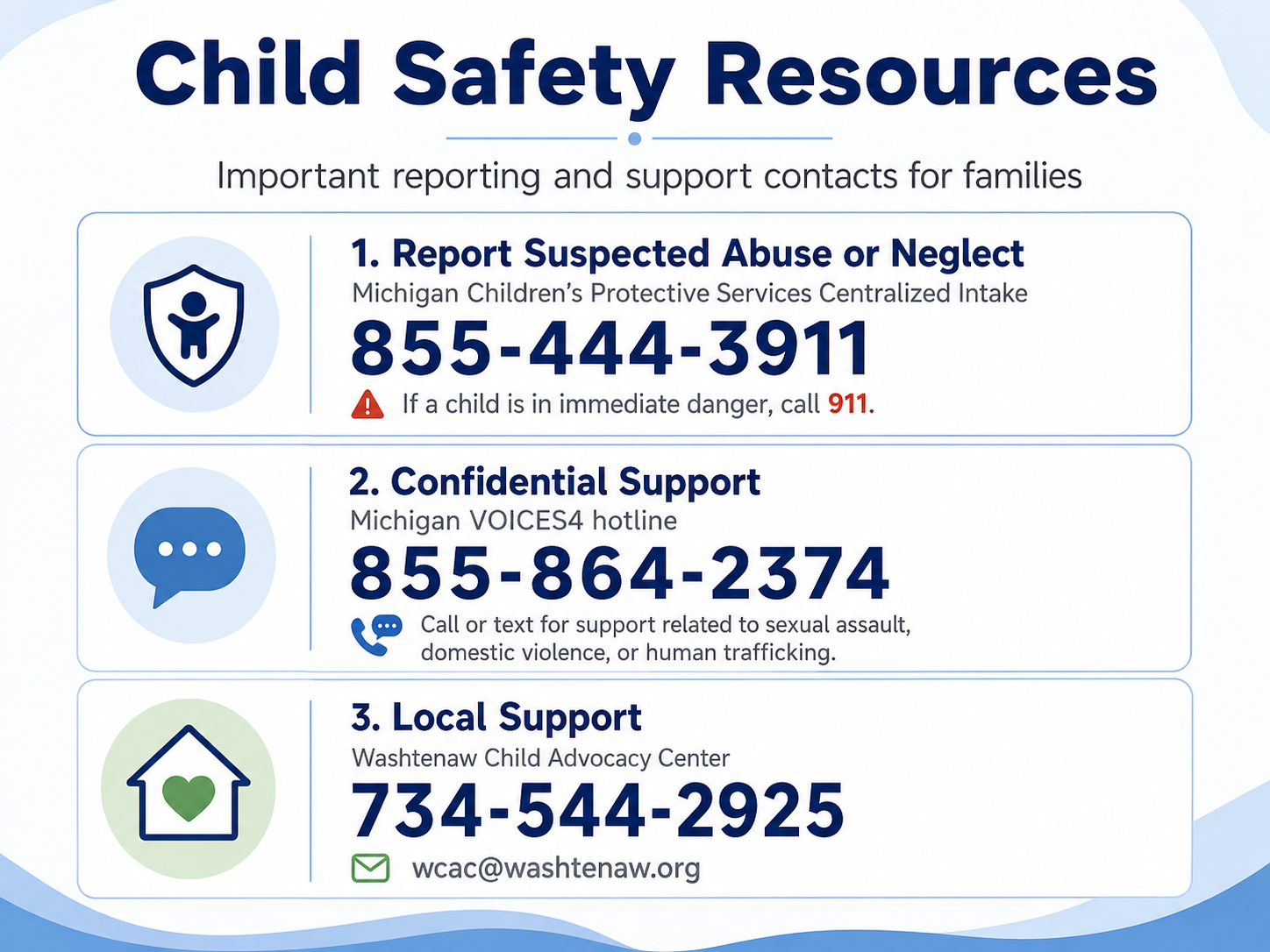
If someone suspects abuse, Batten said they should report it to Michigan’s Children’s Protective Services Centralized Intake line at 855-444-3911. If a child is in immediate danger, call 911. For confidential support related to sexual assault, domestic violence or human trafficking, Michigan’s VOICES4 hotline is available by call or text at 855-864-2374. The Washtenaw Child Advocacy Center can be reached at 734-544-2925 or [email protected].












 114 North Main St Suite 10 Chelsea, MI 48118