

Editor’s Note: As the nation marks its 250th anniversary, the Dexter Area Historical Society presents a series exploring Dexter’s history within the broader context of state and national events. The fourth article looks at three of our nation’s wars and the participation by and effect on our citizens.
Aside from a few skirmishes, Michigan has escaped armed conflict on its soil. However, Washtenaw County residents have participated in and supported the country’s war efforts.
Dexter Answers the Call During the Civil War
After the attack on Fort Sumter by the Confederacy in April of 1861, the call went out across the country for soldiers. On Friday, April 26, the Michigan Argus reported:
“Washtenaw County furnishes three companies for the First Regiment. Washtenaw is true as steel and never lags.”
The May 3, 1861, Michigan Argus reported that the Dexter Union Guard filled up 80 able-bodied men. The Guard, led by A. D. Crane and Harrison Jeffords, joined the Fourth Michigan Regiment as Company K. Before they departed, the ladies of Dexter presented them with a flag, oilcloth capes, Havelock cap covers, and housewives. A housewife was a small portable sewing kit.


Support From Home Sustained Local Soldiers
The soldiers passed a resolution thanking the ladies:
Resolved, That we earnestly solicit the ladies of Dexter to receive our fervent acknowledgment of favors received, and our lasting gratitude for their united and zealous labors, in providing and contributing comforts that tend to relieve campaign life of many of its privations, ….
The regiment fought valiantly at Gettysburg and there is a monument to them at the Wheatfield battle grounds. Harrison Jeffords died there saving the regimental flag. He is buried in Dexter in Forest Lawn Cemetery. Dexter has a street named in his honor and the Dexter GAR chapter bears his name.

The monument in the Wheatfield at Gettysburg honors the 4th Michigan Brigade. Photo courtesy of DAHS
The inscription on the back reads in part:
This monument marks the position held by the regiment July 2nd 1863.
Present for duty—27 officers—376 men—total 403.
Killed 1 officer 24 men. wounded 9 officers 55 men. Missing 1 officer 75 men total 165.
Colonel Harrison H. Jeffords Fell Mortally Wounded at this point,
Thrust through by a bayonet in recapturing the colors of his regiment.
World War I Brings Patriotism and Sacrifice to Dexter
As with the Civil War, local residents rallied their support for the country during WWI and WWII.
During WWI several Dexter women, including Mrs. Flora Smith, who was one of Dexter’s early historians, were commissioned by the governor to work as a Women’s Preparedness Committee. Their main task was to promote the sale of Liberty War stamps and thrift stamps. In 1918, the US government launched a war bond program to help finance the war effort.
To accommodate those who could not afford a bond, the government offered war stamps and thrift stamps. War stamps yielded $5.00 when they matured in 1923 and initially cost $4.12. The cost increased slightly each month. Thrift stamps initially cost $.25 each but had no value until 16 stamps were accumulated and then redeemed for a war stamp.
For the year 1918, Dexter’s portion of Washtenaw County’s one-million-dollar quota was $26,300. They held rallies, door-to-door campaigns and even enlisted school children to help with the sales. Newspapers were filled with articles, advertisements and progress reports.
The Red Cross was also active in Dexter. Several local chapters were formed including junior chapters. They sewed pajamas, knit sweaters and socks and sent packages to the local soldiers.

War Bonds, Rationing and the WWII Home Front
During WWII, there was an all-out citizen effort in Dexter. A rationing office was set up in Dexter High School. Families were required to report how many canned goods they had on hand, but home-canned goods were not counted against the assigned ration points. Books of stamps for purchasing gasoline, coffee, canned goods, meats and sugar were issued per family. Grocery store ads listed the ration points required for each item.
War bond rallies were held. Local properties, including the bank, John Hoey’s ten-gallon hat, and his Tally–Ho carriage, were “auctioned” off for war bonds with proceeds reaching over $20,000.

Local Industry and Students Join the War Effort
Vadim Smyrnoff and Hilarian and Vladimer Bibicoff set up S & B Machine Shop on Main Street in Dexter. They were Russian immigrants who had fled Russia during the Russian Revolution. They owned businesses in the area and expanded to the empty storefront (formerly Kroger) next to the hardware store on Main Street to manufacture airplane parts for the war effort. They were supportive of the effort in other ways as well, sponsoring bond rallies and war charity events.
Scrap rubber and tin drives were held, and horse and buggies were used by local merchants to save rubber. High school students organized scrap collections with proceeds added to a Red Cross fund. In 1942, shortly after Pearl Harbor, the Dexter student body chose the nickname Dreadnaughts for their sports teams. The Dreadnaught was a heavily armed battleship of the early 20th century and was at the time a symbol of national power.
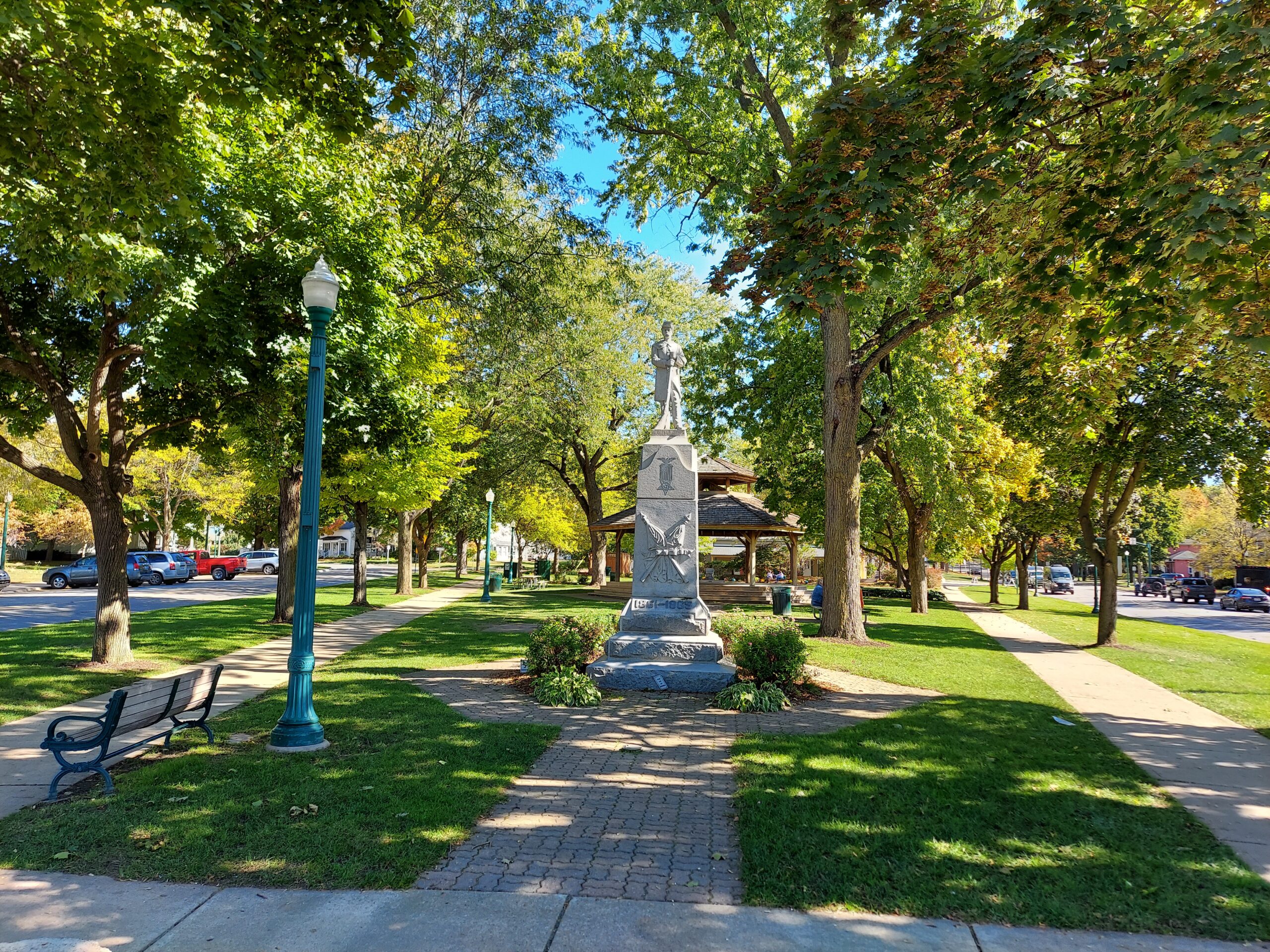
Featured photo: Monument installed in Dexter in 1898. Located in what is now called “Monument Park,” the statue originally honored all soldiers who fought in the Civil War. In 1943, a plaque was added honoring all who served in the armed forces. Photo courtesy of DAHS










 114 North Main St Suite 10 Chelsea, MI 48118