



Editor’s note: As the 82nd anniversary of D-Day approaches on June 6, The Sun Times News is honored to share a remarkable series of stories about Chelsea-area veterans whose lives were forever shaped by World War II. Drawn from extensive interviews, letters, photographs, and local history research by Cynthia Furlong Reynolds, these accounts preserve the voices of men who witnessed some of the war’s most defining moments, from Omaha Beach to the skies over Normandy.
ELLIS BOYCE
“I still get nightmares.”
The Man Behind the Famous Photograph
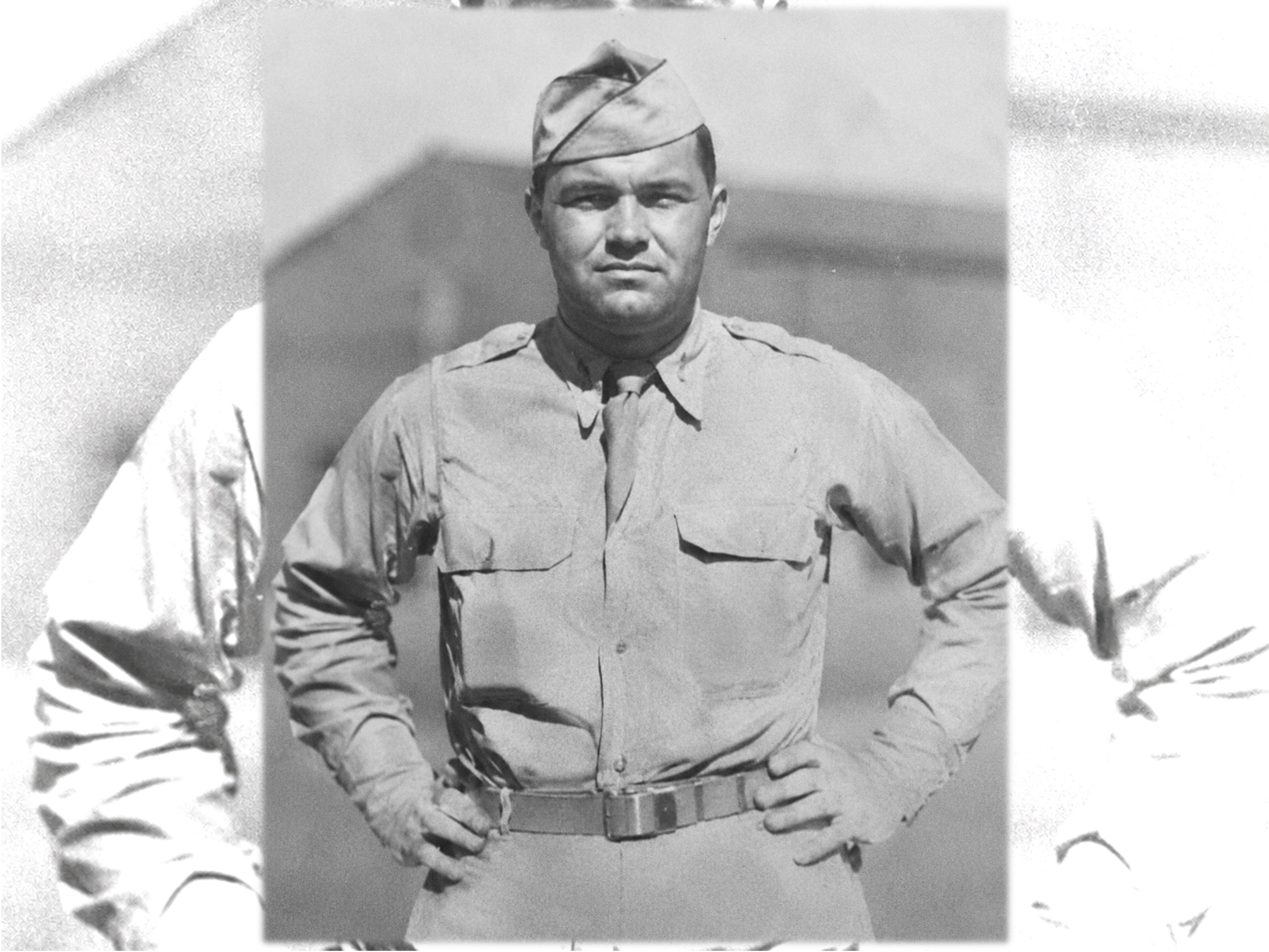
Ellis Boyce (1916-2011) was drafted during peacetime and inducted into the Army on July 24, 1941, almost six months before Pearl Harbor. Following Officer Candidates School, he became a Signal Corpsman, amongst the first to go ashore during invasions. Captain Boyce’s story is told in the World War II Museum in New Orleans. Tom Hanks’ crew tracked him down and proved that as the only Signal Corpsman to survive the first wave of soldiers landing, he made the cover of Life magazine’s D-Day issue, which shows him swimming to shore with a 90-pound pack on his back and the Signal Corpsman’s insignia on his helmet. He was one of the few servicemen to fight both in Europe and the Pacific. “When I went into the Army, I weighed 230 pounds. When I left the Army, I weighed 120 pounds.”
Sailing Toward Normandy
“My JASCO (Joint Assault Signal Company) was trained to provide ship-to-shore and ground communications to coordinate naval shelling and ground activity. On June 3, we boarded a transport ship in Southampton and sailed after dark on June 5 for the invasion of Normandy. We were well prepared for the tasks at hand—or so we thought.
“The Channel crossing was terribly rough. Seasickness became a big problem. We reached our scheduled area, eleven or twelve miles off the coast of France, around 2:00 a.m., and we were supposed to land on Omaha Beach at 6:40 a.m., ten minutes after the first wave. We rode in on LCVP boats designed to go to the water’s edge and drop a ramp so the men would unload onto dry land. At the same time, thirty-two waterproofed tanks were supposed to float in and furnish gunfire five minutes before the first wave of troops. But the plans went awry immediately.

“As near as I can remember, we started climbing down rope mesh ladders from our ship onto the LCVP (Landing Craft, Vehicle, Personnel) about 3:00 a.m. Each of us carried a 90-pound backpack with C-rations (canned food) and D-rations (a fortified chocolate bar), half a tent, blanket, mess gear, and clothing, as well as a .30-caliber carbine with an ammunition belt, fold-up shovel, and gas mask. I also had field glasses, a map case, and a .45-caliber automatic pistol. My men carried a radio, telephone, and wire.
“The LCVP was bobbing up and down as much as eight feet, so loading 36 heavily armed troops was difficult. Meanwhile, the Americans were bombarding the Germans guarding the beach with everything they had. First the Air Force dropped bombs, then the Navy warships and rocket launchers started firing. It was an awesome display, and it convinced us that the landing would be much easier than our officers had predicted.
“We were wrong.

Into the Surf Under Fire
“Shortly after loading, the LCVPs started taking in water from the heavy waves. We were drenched, and forced to unload in water up to—or over—our necks. Many men lost their footing and drowned.
“When the survivors were waist-deep in the water, the German guns opened fire. Anyone upright was cut down. I kept my body in the water, pushing ahead with my feet. Very quickly, there were a lot of bodies floating around me and wounded men splashing as they tried to wade ashore. Able-bodied GIs tried to pull the wounded towards the beach, but the constant German bombardment of the open beach made it impossible to protect or help them after reaching shallow water.
“The Germans had planted what we called Belgian Gates—upright iron frames, then a ten-foot-deep line of heavy wooden stakes angled towards the sea. Behind, they set steel “hedgehogs,” five-feet-high steel X’s angled to stave in the bottoms of landing craft. The going on the beach was really tough.
“I managed to grab hold of debris and float to shore with only my nose and eyes above the water. The only man I could see close to me was a young infantryman who raised his head to look inland. A bullet hit him in the forehead and came out his cheek. That sight gave me nightmares for many years.
Omaha Beach: A Killing Ground
“We realized as soon as we arrived that Omaha Beach was not a good place for an amphibious assault. The beach was covered in coarse pebbles and sloped down to the water, which made it hard to get a footing—particularly since we landed at low tide. Beyond the beach were sand dunes and then cliffs one hundred feet high. The Germans were stationed at the top of the cliffs in concrete bunkers with powerful artillery. Movement forward was nearly impossible for most vehicles. Only one of the first 32 tanks managed to get to shore, so the troops in the first waves had to advance up a beach that had no cover other than mined obstacles.
“If they managed to get beyond the beach, GIs had to deal with a thick barricade of coiled barbed wire. Behind this, the Germans had mined the plateau and dug anti-tank ditches. They had situated 75- and 88-millimeter guns so that no inch of Omaha Beach was left uncovered by fire. The guns were protected by concrete walls three feet thick. At each strongpoint, the Germans had built a system of concrete pillboxes, gun casemates, mortar pits, firing trenches, and open areas where artillery and anti-tank guns were located, surrounded by wire and minefields. All this was connected by underground bunkers and tunnels, we learned later, as we fought our way inland.

Fighting Beyond the Beach
“When I got to the beach and conferred with my men, I realized my radio equipment had been lost in the landing. Meanwhile, the Germans’ artillery was even more murderous on shore. I ran to consult with an officer lying on the beach. As he turned to speak with me, a bullet shot through his helmet and out his ear. He was dead.
“As more men reached the high-tide line, we started to work our way across the grassy area. One of my men stepped on a landmine and lost both of his legs. We quickly administered what First Aid we could and left him in a foxhole. Enemy fire was aimed at us as we started up the hill. Only four or my men were left. They were carrying two telephones, but we had lost our radio and other equipment, so there was no way of communicating with the infantry, our Navy liaison party, or the ships. We couldn’t do our job. We were forced to improvise, each man fighting his own way to the Germans.
“All this time, there was no organized movement of Americans because of the number of casualties, all the obstacles, the terrible German firepower, and our loss of equipment when we unloaded in deep water. I pulled out my field glasses and spotted a radio and ran to it. It seemed intact, so I started back carrying it. I reached my group safely, only to find that the radio had been hit while I was running, and it was useless. That radio kept me alive, but I felt like a failure, unable to do the job I’d been trained to do.
“Finally, I managed to locate the naval liaison officer from an adjacent team that had lost their forward observer, so I took his place. We fought our way up the cliff, every inch of the way. Late in the afternoon, near the top of the hill, we found an abandoned rifle emplacement. Shortly before dark, we saw two German helmets moving. We thought the Germans were counterattacking, but they turned out to be prisoners being taken to the beach. We spent our first night in that abandoned emplacement.”
Postscript: The stories are adapted from Reynolds’ forthcoming book, A Village at War, now in final editing. Through these narratives, readers will gain insight not only into battlefield experiences, but also into the courage, sacrifice, and resilience of an entire community during wartime.
Featured Photo: Drafted before the war began, Ellis Boyce fought in both the Atlantic and Pacific theaters. A photographer captured a photo of him swimming to Omaha Beach, and it was the Life magazine cover shot for the D-Day edition. Photo from OUR HOMETOWN: America’s History Seen Through The Eyes of a Midwestern Village by Cynthia Furlong Reynolds










 114 North Main St Suite 10 Chelsea, MI 48118