


Editor’s note: In recognition of the 82nd anniversary of D-Day on June 6, The Sun Times News is honored to share a remarkable series of stories about Chelsea-area veterans whose lives were forever shaped by World War II. Drawn from extensive interviews, letters, photographs, and local history research by Cynthia Furlong Reynolds, these accounts preserve the voices of men who witnessed some of the war’s most defining moments, from Omaha Beach to the skies over Normandy.
RICHARD KINSEY
“Are you trying to kill me?”
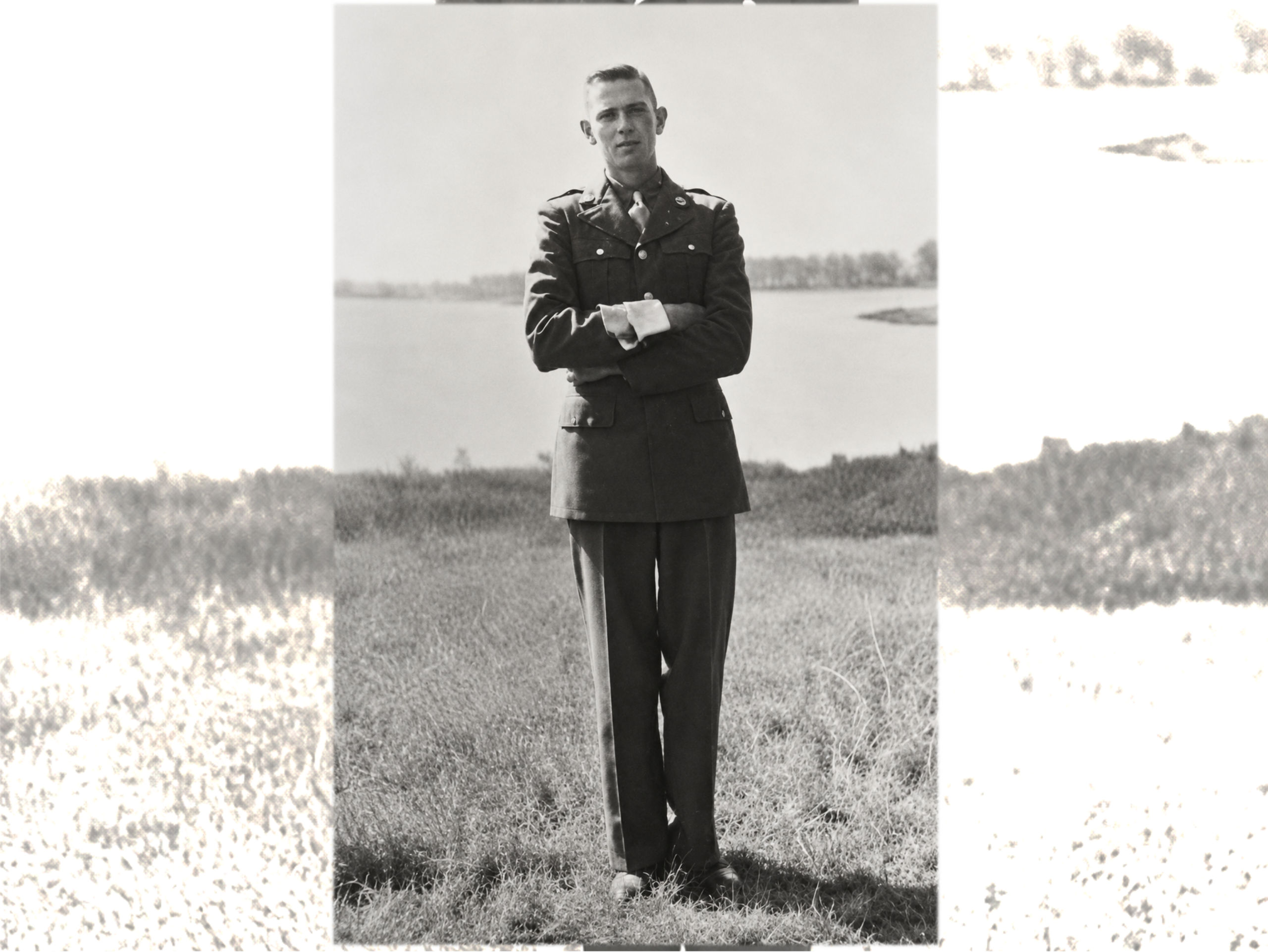
Author’s note: Richard Kinsey (1924-2017) was a high school senior when war was declared. He participated in some of the worst fighting during the early days of the Normandy invasion. Although he arrived in Normandy shortly after D-Day, Kinsey was not wounded on Omaha Beach. He was wounded weeks later after the capture of St. Lô, when German aircraft attacked his unit as it returned to the front.
Chelsea Senior Answers the Call to War
“The draft notice was delivered to my home late in 1942. I can still tell you my serial number: 36584375. I went to Detroit for induction with two classmates: Stanley Karowski and Bill Rademacher. We chose the Army because we wanted to stick together—ironically, right after training, we were scattered and never did see each other again until after the war. Stan was sent to the jungles in the Pacific, I landed in Normandy shortly after D-Day, and Bill froze his feet during the Battle of the Bulge. Somehow, miraculously, we all survived.
“I was assigned to the 106th Infantry, but became a replacement in Company “A”, 116th Regiment, 29th Infantry. On D-Day, the 106th landed on Omaha Beach with 200 soldiers; 5 were left at the end of the day. Sobering numbers. Those boys had gone through a terrible, horrible ordeal.

“The beach had been secured by the time we arrived, and most bodies had been cleared away. On D-Day+3 and +4, the fighting in the hedgerows was still fierce as we made our way inland. I was a mortar man, but when I first went into combat, there were no mortars for me to fire, so I was given a 30-caliber machine gun. Night duty was especially difficult. In the pitch black, noises seemed magnified and ominous. The Germans were a constant threat, since they infiltrated our lines at night. Once I heard a crackling nearby that sounded like twigs snapping. I told myself that if I heard one more snap, I’d open up the machine gun. I was ready to pull the trigger when out walked a big black-and-white cow. I can laugh about it now, but that was one of my scariest moments during the war.

Fear, Foxholes, and the Hedgerow War
“Don’t let anyone tell you that combat isn’t frightening. It’s terrifying, especially the first night. But more than that, it’s very, very exciting. There is no rush like the rush of battle. And when you make it through and you realize you’re not killed, you think you just single-handedly won the war.
“When you’re fighting like we did, you just see a small segment of a battle: the fighting that takes place immediately around you. I remember digging my first foxhole like it happened yesterday. The Germans were one hundred yards from us, hidden in hedgerows that we couldn’t push or cut our way through. As they shelled us, I dug into that rocky ground with the shovel I carried on my back, to get cover. My blisters were so bad that my hands were bleeding.
“Oddly, I was one of the few men who could sleep soundly in a foxhole at a minute’s notice, which is a gift if you’re a soldier. As we moved inland, we found German foxholes—they were far different from ours. The Germans had dug them four or five feet deep, with steps leading down. One German had stripped a farmhouse of its door—still with the curtains on it—and used that as a cover.
Learning to Kill—and Survive
“The first time I saw a German up close, he had somehow gotten lost on the wrong side of the row. The soldier next to me yelled, “There’s a German—shoot him!”
“You shoot him!” I shouted. I’d done a lot of shooting by that time, but at that moment I realized that it’s very hard to pull the trigger on a human being up close and in cold blood when you can see his face. He got back to the other side of the hedgerow before either of us shot at him. That hesitancy never happened again, though.

The Bloody Fight for St. Lô
“Our first objective was to capture the town of St. Lo, and it took us two or three weeks to do it. St. Lo sat on very high ground, and the Germans were watching us—and shooting at us—from the steeples and towers. After an initial bombing run of five hundred or so planes, the Air Force couldn’t help us out because of bad weather, so St. Lo became a nasty, dragged-out battle. I was carrying two machine gun cartridge carriers and trying to get over a hedgerow when a German sniper who had tied himself in a tree shot at me. He creased my helmet and drew blood. I jumped into the hedge, but had to go back for the cartridges. Finally, we brought the big guns to bear on the Germans.
Wounded Under the Flares
“By the time we took St. Lo, only five or six men of the original 200 were left in my company. We went back, regrouped, and I was made a sergeant. Then we returned to the front immediately. At night, German planes would fly over us with flares that lit up the sky like day, followed by strafing planes with 20-millimeter cannons. In the light of the flares, we were supposed to freeze, but the first time this happened, we dove for cover and were strafed by the next plane. My entire squad was shot up. I was hit in both arms, the side of my head, and my chest.
“You do strange things when you realize you’ve been shot. I had seen an officer shot in the head just moments earlier, and my first thought was to put a bandage around my head, even though the other wounds were much worse.
“I walked back towards the rear until two Frenchmen ran up to me and brought me to an ambulance. I was covered in black dirt and blood.”
Postscript: The stories are adapted from Reynolds’ forthcoming book, A Village at War, now in final editing. Through these narratives, readers will gain insight not only into battlefield experiences, but also into the courage, sacrifice, and resilience of an entire community during wartime.
Featured photo: Richard Kinsey, a Chelsea High School senior when World War II began, served with Company “A,” 116th Regiment, 29th Infantry Division during the Normandy invasion. Wounded in fierce fighting near St. Lo after D-Day, Kinsey was among the first soldiers believed to be medically evacuated by aircraft to England. Photo from OUR HOMETOWN: America’s History Seen Through The Eyes of a Midwestern Village by Cynthia Furlong Reynolds












 114 North Main St Suite 10 Chelsea, MI 48118