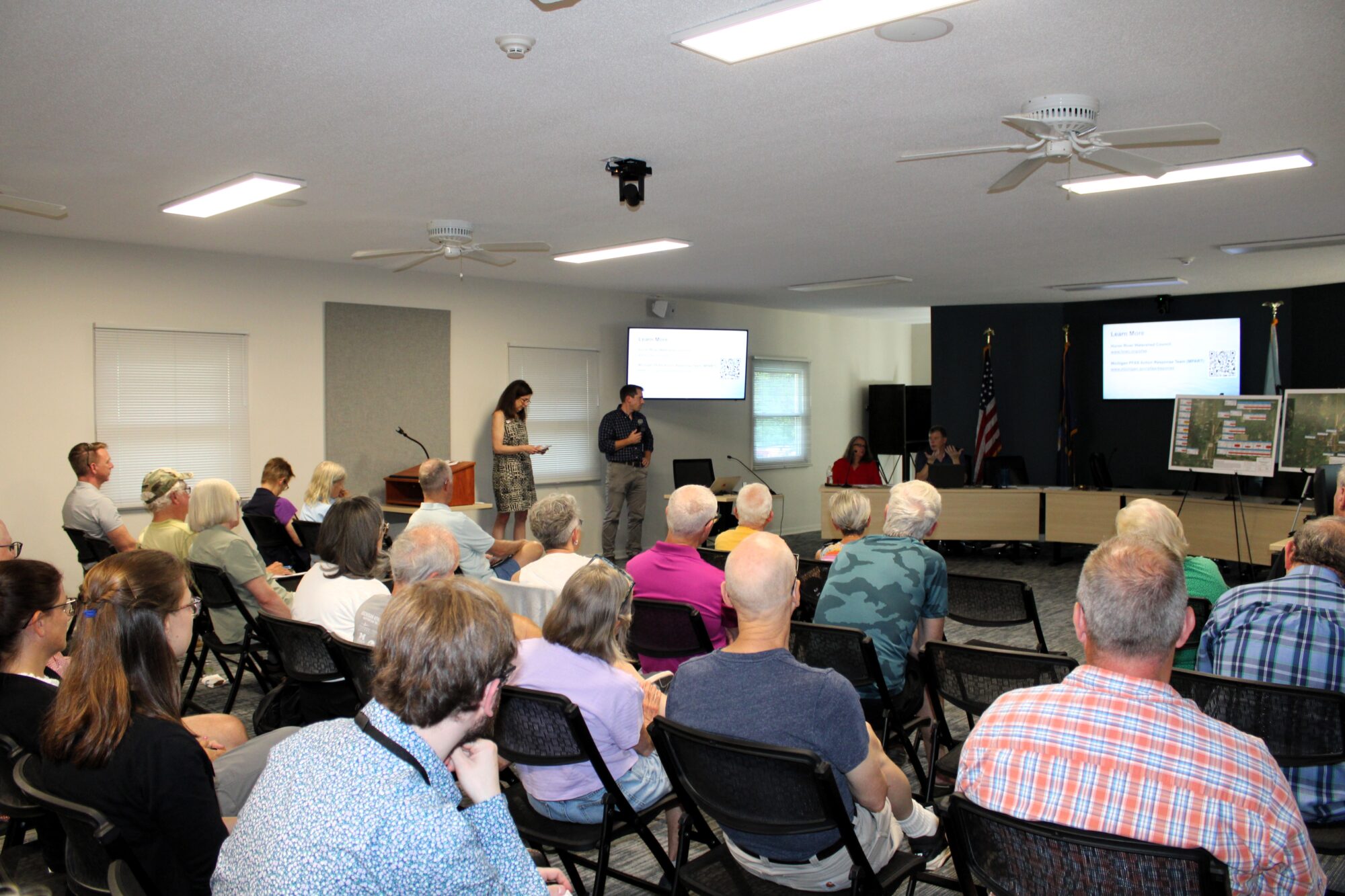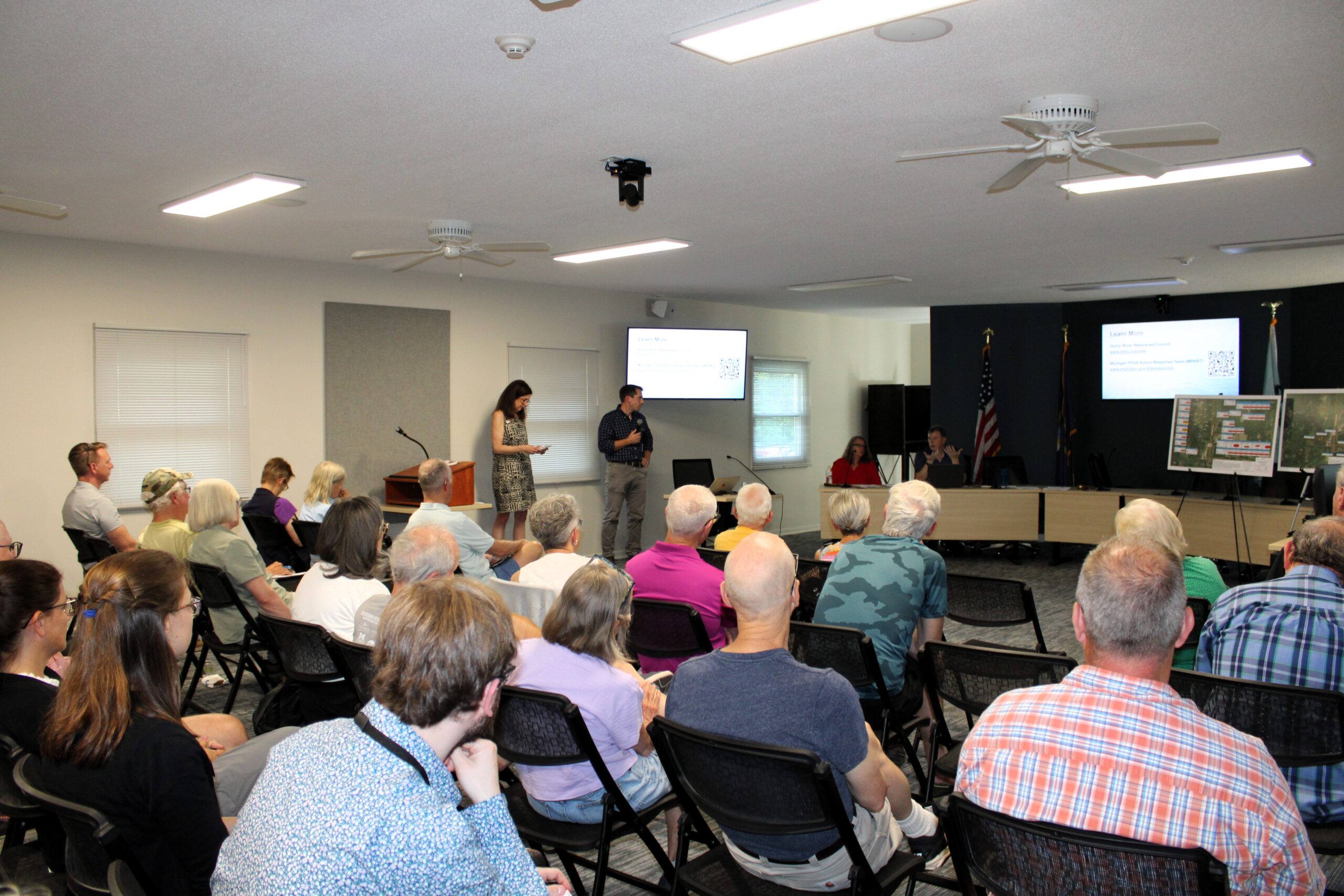


Residents at a June 11 community meeting heard a mix of reassurance and caution about PFAS in the Multi Lake Water and Sewer Authority system: The chemicals have been detected in wastewater and monitoring wells, but not in residential drinking water wells tested near the treatment plant.
The meeting at Dexter Township Hall was the first of two sessions hosted by MLWSA and the Huron River Watershed Council to explain grant-funded test results, answer questions and discuss ways people can reduce exposure. MLWSA serves portions of Dexter, Lyndon, Putnam and Unadilla townships.

What Testing Found
Kathleen Root, director of MLWSA, said testing began after the Michigan Department of Environment, Great Lakes, and Energy sampled the wastewater treatment plant’s influent, effluent and monitoring wells in 2022. MLWSA later expanded the work through grant funding, with samples taken at the plant, in monitoring wells and throughout the collection system.
Root said PFOA, a type of PFAS, was found above Michigan’s standard in all three monitoring wells tested. The highest result was 22.2 parts per trillion. Michigan’s standard for PFOA is 8 parts per trillion.
“It’s really important for you all to understand that the wastewater treatment processes that occur at our plant do not currently remove PFAS,” Root said.
PFAS, short for per- and polyfluoroalkyl substances, are long-lasting chemicals often called “forever chemicals” because they do not readily break down.
Ted Erickson, who has helped MLWSA with the testing effort, said PFOA was the only regulated PFAS type detected above the drinking water standard. Monitoring wells are not drinking wells and tend to be shallower, making them more vulnerable to contamination.
“The very good news here is that in sampling the residential drinking water wells, no PFAS were detected in the drinking water wells,” Erickson said.
Daniel Brown, HRWC’s emerging contaminants specialist, said the findings point to a broader problem, not a single local source.

“Importantly, PFAS have not been found in drinking water,” Brown said.
Brown said the nearly all-residential service area shows how widespread PFAS use is in consumer goods and household materials.
“This is not a challenge limited to MLWSA,” Brown said. “Hamburg Township and many other rural, residential communities across Michigan are dealing with the same issue.”
How Residents Can Reduce Exposure
Brown also focused on practical ways residents can reduce exposure. He said residents do not need to eliminate every possible exposure at once, but should focus first on what they drink and eat.
“Ingestion is the critical pathway to reduce,” Brown said.
For residents with private wells, speakers said testing can provide peace of mind, especially for those near known contamination sites or other possible sources. PFAS testing for a private well currently costs about $250 to $350.
Several residents also asked about reverse osmosis filters. Brown said they can be effective at reducing PFAS in drinking water if PFAS is found in a well, but speakers encouraged residents to test first.
“If your well water tests clean, you might not need a reverse osmosis system,” Brown said.

Brown pointed anglers to the Michigan Department of Health and Human Services’ Eat Safe Fish Guides. The 2026 Southeast Michigan guide lists tested fish and gives serving recommendations based on chemical levels found in the fillet, the part people typically eat.
He also pointed to repeated-use products where residents can make practical changes, including toothpaste, sunscreen, cosmetics, shampoos and cookware. MDHHS says products described as waterproof, water-repellent, nonstick, stain-resistant, grease-resistant or oil-resistant are more likely to contain PFAS.
Brown said one easy step is switching from nonstick pots and pans to stainless steel or cast iron. MDHHS also advises throwing away scratched or damaged nonstick cookware, dusting and vacuuming regularly, and washing hands before preparing food.
Brown also advised residents to avoid foam on rivers and lakes because PFAS can concentrate there, sometimes at levels thousands of times higher than the surrounding water. He said that makes it especially important for children and pets to stay away from foam. If contact happens, he said residents should rinse it off and wash up afterward.
Residents attend a June 11 PFAS community meeting hosted by the Multi Lakes Water and Sewer Authority and the Huron River Watershed Council.

Next Meeting
The second PFAS community meeting is scheduled for 7 to 8:30 p.m. Wednesday, June 24, at Putnam Township Hall, 3280 W. M-36, Pinckney.












 114 North Main St Suite 10 Chelsea, MI 48118