

A piece of Washtenaw County history is preparing for a new chapter.
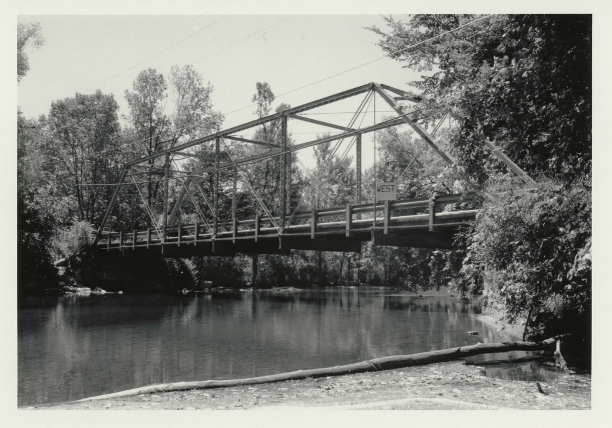
After more than a century spanning the Huron River on Bell Road, the 1891 Bell Road Bridge has been carefully dismantled and placed into storage by the Washtenaw County Road Commission. The historic iron truss bridge is expected to be reconstructed as part of the Border-to-Border (B2B) Trail’s Dexter Connection project, where it will carry pedestrians and cyclists across Mill Creek into Mill Creek Park.
The relocation will preserve one of Michigan’s rarest surviving historic highway bridges while giving it a new purpose for generations of trail users.
Originally built in 1891 by the Wrought Iron Bridge Company of Canton, Ohio, the bridge served Bell Road at the Huron River in Dexter Township for well over a century. It is a single-span Pratt through truss bridge measuring 103 feet, 6 inches long and 13 feet, 5 inches wide, resting on fieldstone abutments. At the time of its National Register nomination, the bridge had already been closed to vehicle traffic because of the deteriorating condition of its stone supports.

The bridge occupies an important place in Michigan’s transportation history.

According to its National Register of Historic Places nomination, the Bell Road Bridge is one of only about 10 surviving nineteenth-century metal through-truss highway bridges in Michigan. It is also one of only a handful of remaining examples built by the Wrought Iron Bridge Company, once one of the Midwest’s largest and most prolific bridge manufacturers. Historians noted that while at least 50 Wrought Iron Bridge Company bridges once existed in Michigan, only five remained by the mid-1990s.

The crossing itself has roots that stretch back even farther.
The bridge stands at the site of the former milling settlement of Dover, established in the 1830s after Judge Samuel Dexter and Isaac Pomeroy built a sawmill on the Huron River. Dover later grew to include a grist mill, hotel, store, blacksmith shop and post office before gradually fading away in the early twentieth century. Little of the settlement remains today beyond the historic bridge site.

Newspaper accounts from the time tell the story of the bridge’s construction. In July 1890, local residents petitioned Dexter and Webster township officials to replace the aging river crossing, which had become “almost a wreck.” Construction of the new iron bridge began in 1891, and by October of that year, The Dexter Leader reported that “One of the finest iron bridges in the county now spans the Huron at Dover.”
Rather than allowing the structure to deteriorate beyond repair, transportation planners chose to preserve it for adaptive reuse. Once reconstructed over Mill Creek, the bridge will become a signature feature of the B2B, connecting trail users into Dexter’s Mill Creek Park while preserving an important piece of Washtenaw County’s engineering heritage in that a bridge built for horse-drawn wagons and early automobiles will continue serving the public in a new role nearly 135 years after it was first erected.
Source: National Register of Historic Places Registration Form, Bell Road Bridge, Michigan State Historic Preservation Office/National Park Service (1996).
Featured photo: The Bell Road Bridge spans the Huron River in this photograph taken for its National Register of Historic Places nomination. Built in 1891 by the Wrought Iron Bridge Company of Canton, Ohio, the historic iron truss bridge will soon begin a new chapter after being reconstructed as part of Dexter’s Border-to-Border Trail, where it will carry pedestrians and cyclists across Mill Creek into Mill Creek Park. Photo courtesy of the National Register of Historic Places, Michigan State Historic Preservation Office/National Park Service.












 114 North Main St Suite 10 Chelsea, MI 48118