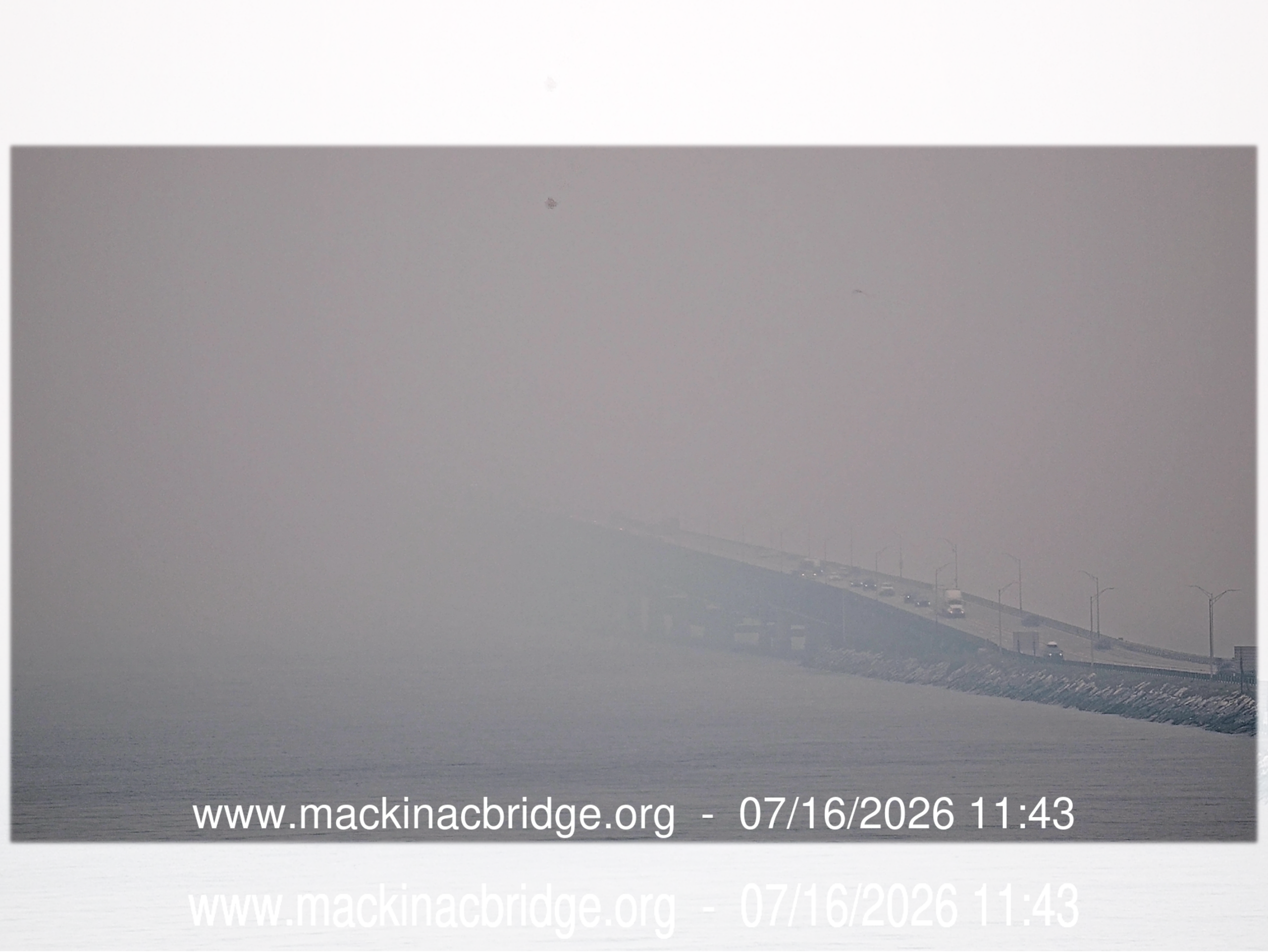



Canadian wildfires can send smoke hundreds or even thousands of miles, affecting air quality far from the flames
For many Michigan residents, smoky summer skies once seemed unusual. In the past few years, however, hazy horizons, orange sunsets and air quality alerts have become increasingly familiar.
So, what’s going on? Why has this become an issue?
Michigan environmental officials describe the recent levels of wildfire smoke reaching the state as unprecedented. In 2023, smoke from Canada produced Michigan’s first statewide air quality alert and an unusually high number of Air Quality Action Days.
The smoke returned during subsequent wildfire seasons, raising a question many may have thought would have sounded strange not long ago: Are smoky summers becoming normal in Michigan?
According to scientists, the answer is complicated. In short, smoke will not cover the state continuously, and some summers will be worse than others. However, Canada’s changing fire conditions mean Michigan may face additional episodes when large wildfires coincide with winds carrying smoke toward the Great Lakes.


Why Does This Seem New?
Wildfire smoke is not new to Michigan, but it was often suspended high in the atmosphere, often producing a milky sky or colorful sunset without seriously affecting the air people breathed near the ground.
What changed dramatically in 2023 was the size and location of the fires, along with repeated weather patterns that brought thick smoke into the eastern United States. Canada experienced its most destructive wildfire season on record that same year. Smoke periodically reached ground level across Michigan, creating unhealthy air instead of merely hazy skies.
Michigan’s Department of Environment, Great Lakes and Energy (EGLE) reported an unprecedented number of air quality alerts during the summer of 2023. Federal and state analyses later connected several unusually high fine-particle readings in Michigan directly to Canadian wildfire smoke.
Years since then have also brought significant Canadian fires and additional smoke episodes, a sign that means the conditions capable of producing widespread smoke are occurring more frequently.
What’s Going on with so Many Large Fires in Canada?
Fire is a natural part of Canada’s vast forests, a natural event that clears older vegetation, releases nutrients, and helps certain trees reproduce.
The change and concern is that more fires are becoming large, intense and difficult to control.
Canada is warming at roughly twice the global average rate, with even faster warming in its northern regions. Higher temperatures pull moisture from vegetation and soil. Earlier snowmelt, prolonged drought, and extended periods of hot, dry weather increase forests’ vulnerability to burning.

Natural Resources Canada reports that the annual number of Canadian wildfires has generally decreased, but the total area burned has increased. In other words, Canada is not necessarily experiencing more ignitions every year; it is experiencing a shift toward fewer small fires and more exceptionally large ones.
It is commonly known that wildfires can begin through human activity or natural causes. Lightning starts about 46% of Canadian fires but accounts for approximately 83% of the land burned. Lightning-caused fires often begin in remote areas, where they may substantially grow before firefighters can reach them.
Climate change is not entirely to blame. Lightning, campfires, equipment, power lines and other sources still provide the spark. Warmer and drier conditions, however, can make vegetation easier to ignite and allow a fire to spread faster, burn hotter and last longer.
Canada’s vast and dense forested areas are another factor. Some fires burn in isolated regions where directly suppressing every blaze would be dangerous, impractical or ecologically undesirable.
Why Does the Smoke Come to Michigan?
Once smoke rises above a fire, it can become part of the larger weather system.

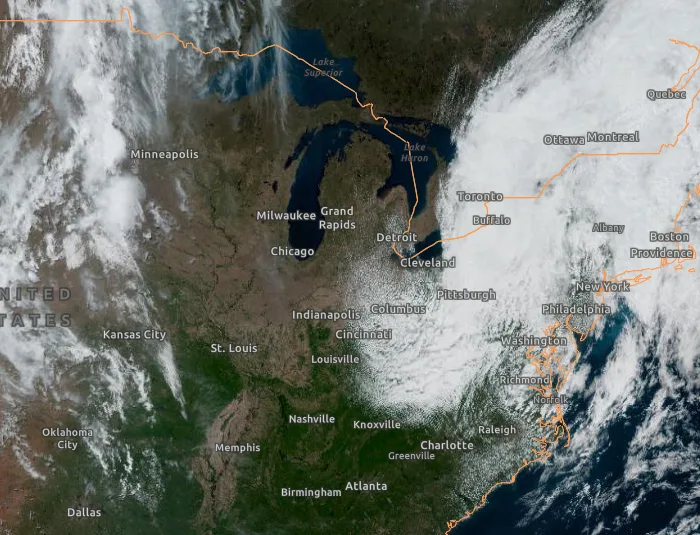
Strong fires can lift smoke thousands of feet into the atmosphere. Winds then carry it across provincial and national borders. Depending on the wind direction and the height of the plume, smoke can travel hundreds or even thousands of miles.
Michigan is especially exposed when fires are burning in provinces such as Ontario, Manitoba, Saskatchewan, Alberta and Quebec. Weather systems moving across Canada frequently turn southeast or circle through the Great Lakes region.
A cold front or low-pressure system can pull smoke southward. Other atmospheric conditions can keep it trapped near the surface. Those details determine either a faint haze overhead or unhealthy air at ground level.
Smoke forecasts can change quickly. Even while Canadian fires continue burning, a shift in the wind can clear Michigan’s skies within a day. Another change can bring the smoke back.
What is PM2.5?
The greatest health concern in wildfire smoke is usually fine particulate matter known as PM2.5.
The name refers to particles measuring 2.5 micrometers across or smaller. They are about 30 times smaller than the width of an average human hair and can be inhaled deep into the lungs. Some particles may enter the bloodstream.
Wildfire smoke contains a mixture of gases, water vapor and particles produced when trees, brush and other organic materials burn. PM2.5 is generally considered the principal public health threat from that mixture.
Exposure can cause burning eyes, coughing, wheezing, headaches, fatigue and difficulty breathing. It can also aggravate asthma, heart disease and other existing conditions.

What Does the AQI Number Mean?
The Air Quality Index, or AQI, converts pollution measurements into a common scale. During wildfire smoke events, the reported AQI is often based on PM2.5.
The scale runs from 0 to 500. The higher the number, the greater the pollution and potential health concern.
- 0 to 50 — Good: Air pollution poses little or no risk.
- 51 to 100 — Moderate: Air is generally acceptable, although unusually sensitive people may experience symptoms.
- 101 to 150 — Unhealthy for sensitive groups: Children, older adults and people with heart or lung conditions should reduce prolonged or heavy outdoor activity.
- 151 to 200 — Unhealthy: Some members of the general public may experience effects, while sensitive groups face greater risks.
- 201 to 300 — Very unhealthy: Everyone faces an increased possibility of health effects.
- 301 to 500 — Hazardous: Emergency conditions may affect the entire population.
When smoke is heavy, experts say residents can reduce exposure by spending more time indoors, closing windows and doors, running air conditioning on recirculation and using a proper portable air cleaner or effective furnace filter. Outdoor exercise should be shortened, moved indoors or postponed.
Where to Check Current Conditions
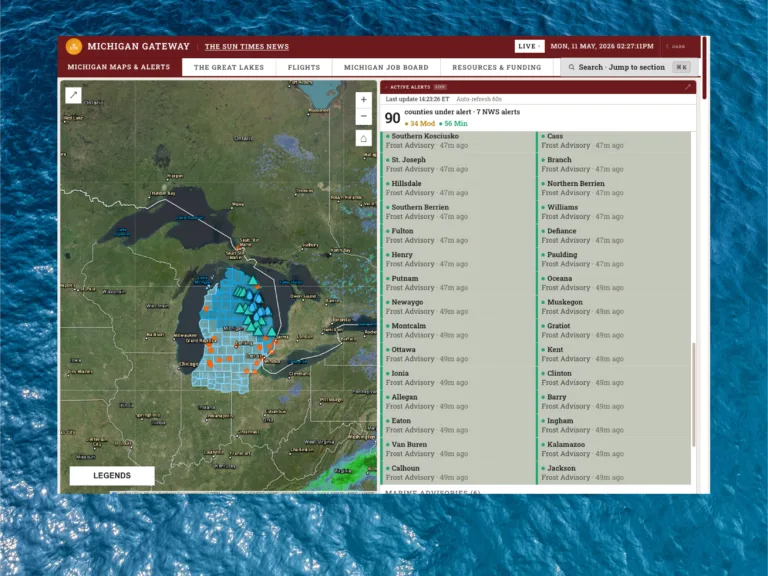
The Sun Times News posts local weather alerts including Air Quality alerts.
Further detail can be found at AirNow.gov, which is operated by the U.S. Environmental Protection Agency and Michigan.gov/EGLE.
Sources
- U.S. Environmental Protection Agency, “Communicating Air Quality Conditions: The Air Quality Index” and “Wildland Fires and Smoke.”
- AirNow, “AQI Basics,” “Wildfires” and the AirNow Fire and Smoke Map.
- Michigan Department of Environment, Great Lakes and Energy, “Wildfire Smoke and Pollution: A Primer on Michigan’s Attainment Status” and “Wildfire Smoke.”
- Natural Resources Canada, “Climate Change and Wildland Fire,” “Canada’s Record-Breaking Wildfires in 2023” and the Fire History Data Explorer.
- National Oceanic and Atmospheric Administration, “NOAA Satellites Monitor Canadian Wildfires and Smoke” and “NOAA Satellites Tracked Historic Levels of Harmful Smoke.”
- National Weather Service, “Smoke From Canadian Wildfires Across the Great Lakes.”
Featured photo: Canadian wildfire smoke shrouds the Mackinac Bridge in haze on July 16, 2026, dramatically reducing visibility across the Straits of Mackinac. Smoke from large wildfires burning in Canada has periodically drifted into Michigan, prompting air quality advisories across parts of the state. Courtesy of the Mackinac Bridge Authority










 114 North Main St Suite 10 Chelsea, MI 48118