




Most of us Michiganders know Lake Superior as the biggest, coldest and wildest of the Great Lakes. It’s famous for shipwrecks, November storms and water so clear it can sometimes look tropical along the shoreline.
But nearly 35 miles north of Munising lies one of the most mysterious places in North America, a dark basin known informally as Superior Maximus, the deepest point in all five Great Lakes.
At 1,332 feet, Superior Maximus is just over a quarter-mile below the surface, deep enough to swallow four Michigan Stadiums stacked one atop another.
And despite sitting inside one of North America’s busiest freshwater systems, it’s a place that humans have barely explored.
Unlike the surface waters enjoyed by boaters and anglers each summer, Superior Maximus exists in perpetual darkness. Sunlight never reaches the bottom. The water remains a nearly constant 39 degrees Fahrenheit year-round, and more than a quarter-mile of water overhead creates nearly 600 pounds of pressure on every square inch, about 40 times what you’d experience at the surface. Imagine an entire quarter-mile column of water stacked directly above you. That’s the force pressing down on everything living at Superior Maximus.

A Unique World in a Unique Lake
The extreme conditions in the world’s largest freshwater lake have some scientists comparing the deep basin to an alien world.
The lake floor consists largely of fine silt interrupted by rocky ridges and scattered boulder fields. Modern underwater explorations have revealed rocks covered with tiny hydra, relatives of jellyfish and coral, forming what researchers describe as underwater forests.
Several unique fish have adapted to live there.
The kiyi, a rare deepwater whitefish, now survives almost exclusively in Lake Superior. Its oversized eyes help it navigate the darkness, and it often cannot survive being brought rapidly to the surface because of the dramatic change in pressure.
The deepwater sculpin spends its life along the bottom, where its flattened head and light-sensitive eyes make it perfectly suited for conditions more than a quarter-mile beneath the waves. The deep water fish is the primary prey for the siscowet lake trout.
Perhaps the king of this hidden ecosystem is the siscowet lake trout, the apex predator of Superior Maximus with an unusually high fat content. Those fat reserves allow it to survive in an environment where food can be scarce.

The Mystery of the “Zombie” Trout
Superior Maximus recently returned to the spotlight because of an unexpected mystery.
During deepwater surveys, Michigan Department of Natural Resources researchers began finding unusually thin siscowet lake trout. Normally among the fattiest fish in Lake Superior, some individuals weighed only about one-third of what healthy fish should.
Researchers nicknamed them “zombie fish.”
Unlike Hollywood zombies, “zombie” fish aren’t thought to have a contagious disease that they are spreading by biting other fish. Rather, the condition is believed to be the result of a lack of food in the deep waters in which they live. These deep waters are prone to ecosystem shifts such as low food availability. This phenomenon was observed only in the deepest parts of Lake Superior in Michigan under extreme conditions.
The increase has been striking. During deepwater surveys, zombie siscowet made up about 3% of catches in 2015. By 2024 and 2025, that figure had climbed to roughly 20%. At Superior Maximus, researchers found the problem was even more pronounced, with more than half of the siscowet caught during the most recent survey classified as emaciated.

Difficult to Explore
It may seem surprising that the deepest place in the Great Lakes remains so mysterious.
The problem isn’t simply depth.
Superior Maximus is a broad underwater basin stretching nearly 19 miles rather than a single pinpoint location. Combined with darkness, cold water and immense pressure, the area is difficult to study even with modern technology.
The first human to reach the bottom did so in 1985 aboard the research submersible Johnson Sea Link II. A year later, another expedition placed a time capsule there as part of Michigan’s sesquicentennial celebration. Its exact location has since been lost within the vast basin.
Not until recently did researchers return for the first major exploration in roughly four decades. Using a remotely operated underwater vehicle equipped with high-definition cameras, the expedition livestreamed footage of the lake floor, revealing rocky slopes, hydra-covered boulders, burbot and deepwater lake trout to viewers around the world.
Michigan’s Hidden Frontier
When people think about unexplored places, they often picture the deep ocean or distant planets.
Yet one of North America’s least-studied ecosystems lies within Michigan waters.
Despite Lake Superior bordering populated communities and attracting millions of visitors each year, scientists have spent far more time exploring portions of the ocean than the deepest reaches of the largest Great Lake. More people have walked on the Moon than have visited Superior Maximus, the deepest place in the Great Lakes.
For most visitors, Lake Superior’s greatest wonders are found along its dramatic shoreline—Pictured Rocks, Isle Royale, waterfalls and beaches of polished agates. But hundreds of feet below the waves is another world entirely, one of perpetual darkness, strange creatures and mysteries that researchers are only beginning to understand.
Lake Superior Fun Facts
It wasn’t always called Lake Superior. The French named it Lac Supérieur, meaning “Upper Lake,” because it lay above Lake Huron in the Great Lakes water system. Before that, the Ojibwe called it Gichigami, meaning “Great Sea.” Henry Wadsworth Longfellow popularized the name in The Song of Hiawatha.
It’s the largest freshwater lake in the world by surface area, holding about 10% of the world’s fresh water. Covering about 31,700 square miles, it’s larger than South Carolina. There’s enough water in Lake Superior to cover North and South America in about a foot of water.
It’s still growing. The land around Lake Superior continues to rise because Earth’s crust is rebounding after being compressed by glaciers during the last Ice Age. This process, called isostatic rebound, is slowly changing the lake’s shoreline.
Sources
- Michigan Department of Natural Resources, Researchers head to Superior Maximus to investigate “zombie” fish (June 8, 2026).
- Hidden Below Superior Maximus, Great Lakes Now, YouTube
- NOAA Great Lakes Environmental Research Laboratory (GLERL)
- Lake Superior Magazine
- Encyclopedia Britannica
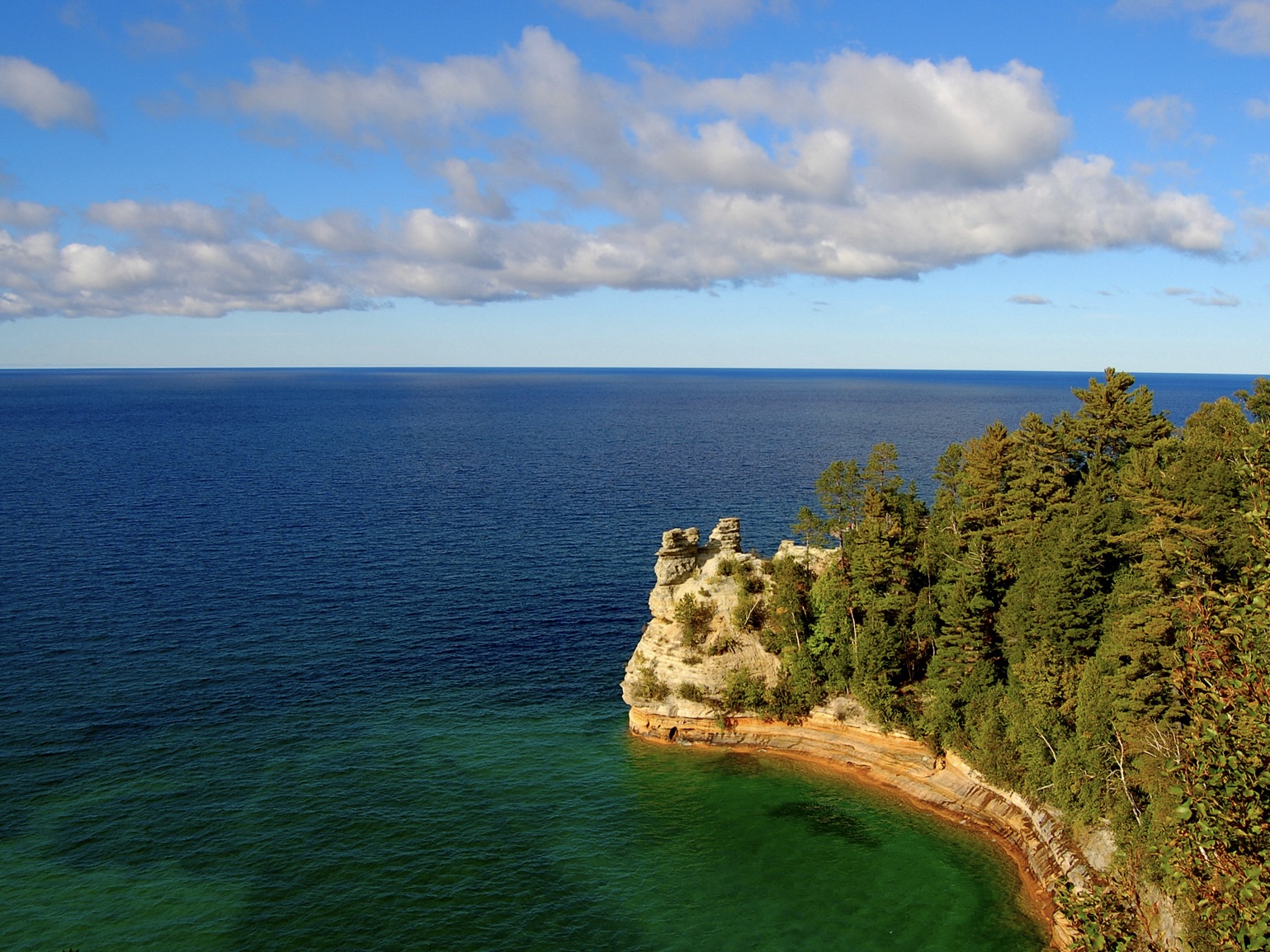
Featured photo: The waters off Pictured Rocks National Lakeshore near Munising hide Superior Maximus, the deepest point in Lake Superior and the Great Lakes, about 35 miles offshore. iStockphoto










 114 North Main St Suite 10 Chelsea, MI 48118